
Here's a human-written, natural-sounding version of the section, following the provided style guide and requirements.
At a glance, the core difference between a honey bee and a wasp is simple: bees are hairy, passive pollinators, while wasps are smooth-bodied, aggressive predators. For homeowners here in Alberta, understanding this distinction is the first step toward safe coexistence or, when necessary, professional removal. One is a vital ally to our gardens, and the other can be a dangerous pest.
Identifying Your Uninvited Flying Guests
When you hear that familiar buzz near your patio or under the eaves of your Red Deer home, it’s easy to feel a jolt of concern. Is that a helpful honey bee just doing its job, or is it an aggressive wasp scouting for a place to build its nest a little too close for comfort?
Getting the ID right in the honey bee vs. wasp debate isn't just for curiosity's sake—it’s crucial for your family’s safety and dictates the right way to respond.
While both are common sights during our warmer months, their roles in our local ecosystem couldn't be more different. Honey bees are pretty gentle by nature, focused entirely on gathering nectar and pollen. They are absolutely essential for our local gardens and agriculture but aren't looking for a fight.
Wasps, on the other hand, especially yellow jackets and paper wasps, are predators and scavengers. They’re the ones drawn to your sugary drinks, picnic meats, and garbage bins, making them the most frequent uninvited guests at any backyard barbecue. Their territorial and aggressive behaviour makes them a much bigger threat.
Key Takeaway: A honey bee’s mission is to pollinate flowers and make honey. It will only sting as a final, desperate act to defend its hive and dies right after. A wasp’s goal is to hunt and scavenge; it can and will sting you repeatedly, often without any real provocation.
This guide is here to help you confidently tell them apart, understand why they behave the way they do, and decide on the safest next step.
First, let's break down the key differences to help you make a quick and accurate identification.
Quick Identification: Honey Bee vs. Wasp
This chart highlights the most obvious visual and behavioural cues to look for.
| Characteristic | Honey Bee | Wasp (Yellow Jacket/Paper Wasp) |
|---|---|---|
| Body Shape | Round, robust, and visibly fuzzy or hairy. | Slender with a very distinct, narrow, "pinched" waist. |
| Colour | Typically a duller golden-brown and black with fuzzy-looking stripes. | Bright, vivid yellow and black with sharp, well-defined patterns. |
| Legs | Hairy legs, and you can often see yellow pollen baskets on them. | Smooth, thin legs that noticeably dangle down when they fly. |
| Behaviour | Generally docile and focused on flowers; they try to avoid people. | Can be aggressive and territorial; often drawn to human food, drinks, and garbage. |
| Sting | Stings only once as a last resort to defend the colony, then dies. | Can sting multiple times aggressively without any harm to itself. |
Paying attention to these simple details—body shape, colour, and how they act around you—is usually all it takes to know exactly what you’re dealing with. A fuzzy, gentle visitor on your flowers is a friend, but a smooth, aggressive insect buzzing around your deck likely needs to be handled with caution.
Comparing Appearance, Behaviour, and Diet
To confidently handle the buzzing insects on your property, you need to look beyond a simple glance and understand why they behave the way they do. The classic honey bee vs. wasp confusion can be cleared up by looking at three key areas: how they’re built, what they eat, and how they act around you. These distinctions tell you everything you need to know about which one poses a bigger threat to your family.
Physical Characteristics
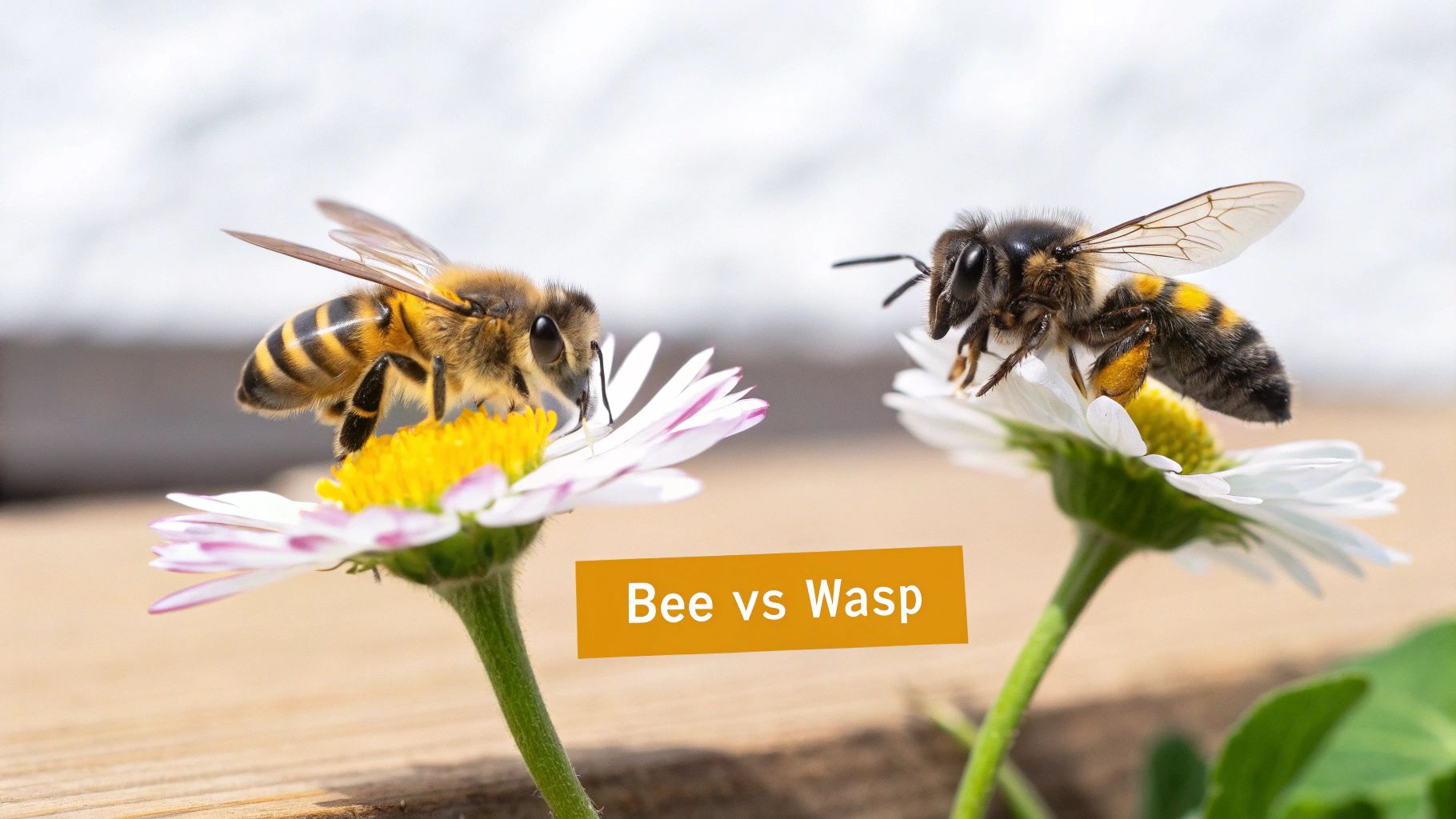
The most reliable way to tell them apart is by looking at their body shape and texture. Honey bees are built for collecting pollen, which gives them a robust, fuzzy, and almost fluffy appearance. Their bodies are covered in fine hairs that trap pollen, and you might even see yellow clumps of it stuck to their thick legs. Their colouring is typically a duller, almost gentle golden-brown and black.
Wasps, on the other hand, are sleek predators. They have smooth, nearly shiny bodies with very little hair. The dead giveaway is their narrow, pinched waist separating their thorax from their abdomen. This iconic “wasp waist” creates a more defined and angular look. Their colours are also much more striking—think bold, bright yellow against sharp black patterns, a clear warning sign from nature.
Diet and Foraging Habits
An insect’s diet directly influences its behaviour and explains why you find them in different places. Honey bees are strict vegetarians, feeding only on nectar and pollen from flowers. They are dedicated pollinators, moving methodically from blossom to blossom with absolutely no interest in your picnic lunch.
Wasps are opportunistic omnivores. While adult wasps might sip nectar or munch on rotting fruit, they spend most of their time hunting other insects to feed their protein-hungry larvae. This predatory drive is exactly why they’re so drawn to your backyard gatherings.
They will scavenge for just about any available food source, including:
- Sugary drinks: Spilled pop or juice is a magnet for them.
- Meats: Leftover burgers, hot dogs, or deli meats are prime targets.
- Garbage bins: An unsecured trash can is an easy buffet.
This scavenging instinct makes wasps a far greater nuisance and threat around homes. Managing these attractants is a huge part of effective warm weather pest control.
The single most important difference for homeowners comes down to the sting. A honey bee stings once defensively and then dies. A wasp is built for aggression; it can sting you repeatedly without any harm to itself, injecting venom with each painful jab.
Behaviour and Aggression Levels
A honey bee’s main goal is supporting its colony through pollination. They are generally docile and will do their best to avoid a confrontation unless their hive is directly threatened. Seeing one in your garden is a sign of a healthy ecosystem, not an immediate danger.
Wasps, especially social species like yellow jackets, are territorial and easily provoked. Their predatory nature makes them inherently more aggressive. They won’t hesitate to investigate people and food sources up close and can attack in swarms if they feel their nest is in danger, making them a significant safety concern.
Identifying Nests and Common Hiding Spots
Knowing where these insects build their homes is the first step in preventing a nasty surprise on your property. When it comes to honey bees vs. wasps, their nesting habits couldn't be more different, reflecting their unique lifestyles. For homeowners in Red Deer, understanding what to look for—and where—is key.
Honey bees are quite particular about where they set up shop. Because their colonies live for years and must survive our harsh Alberta winters, they search for large, insulated, and well-protected cavities. You will almost never find an exposed honey bee nest.
Instead, they build their intricate honeycomb structures from beeswax deep inside hollow trees, wall voids, or unused chimneys. These nests can house tens of thousands of bees and are incredible feats of natural engineering, but they absolutely require expert handling if you find one in your home.
Wasp Nest Characteristics
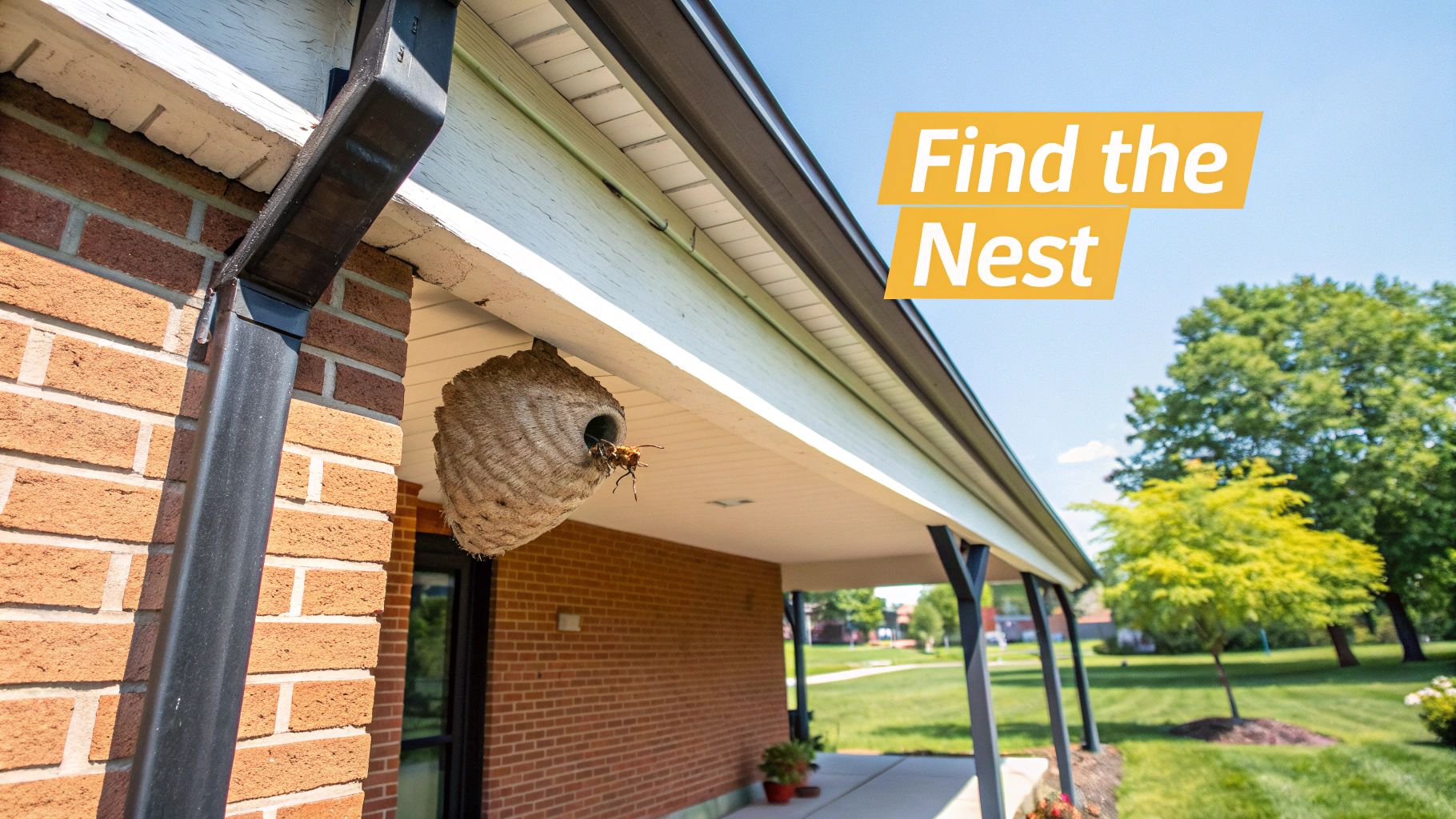
Wasps, on the other hand, build a brand new nest from scratch every spring. Their homes are made from a distinct paper-like material, which they create by chewing up wood fibre and mixing it with their saliva. The nest’s appearance and location will tell you exactly which species you’re dealing with.
- Paper Wasps: These build those classic, open-faced, umbrella-shaped nests you might see hanging in a protected spot. Look for them under deck railings, beneath the eaves of your roof, or tucked inside play structures.
- Yellow Jackets: This is where things get more dangerous. While some yellow jackets build aerial nests similar to paper wasps (but fully enclosed), many in Alberta nest underground. They love taking over abandoned rodent burrows or building inside retaining walls, making them nearly invisible and dangerously easy to disturb.
The easiest way to tell them apart comes down to visibility and material. Honey bee nests are hidden and made of wax. Wasp nests are often visible and look like they’re made of grey, papery pulp. If you see a lot of activity around a hole in the ground, it's almost certainly a yellow jacket colony and should be treated as extremely hazardous.
Making the right identification is important for more than just safety; it has ecological and economic implications too. In an agricultural province like Alberta, honey bees are incredibly valuable assets. To put it in perspective, California's beekeeping industry once generated over $175.9 million in gross income, with much of that from honey and beeswax sales. Wasps, however, are mostly seen as pests that can sting repeatedly. While our climate is different, this highlights the immense value of bees, making their safe relocation a top priority when nests are found. You can read more about the economic impact of bees from UC Davis.
For homeowners here in Red Deer, doing regular checks of your shed, deck, and siding is a must. Spotting a small, emerging wasp nest in May is far simpler to manage than a football-sized hive full of thousands of aggressive defenders in late August.
Understanding The Risks: Stings and Property Damage
When you spot a buzzing insect near your home, your first thought is probably about safety. And for good reason. While both honey bees and wasps can sting, the actual risk they pose to your family and your home is quite different. Knowing what you're up against is the first step in handling the situation correctly here in Alberta.
The biggest difference between a honey bee and a wasp comes down to how they defend themselves. A honey bee’s stinger is barbed, so it gets stuck in the skin. This is a final, defensive act for the bee—it dies soon after stinging, which is why they usually only sting if their hive is directly threatened.
Wasps, on the other hand, have a smooth stinger. They can sting you again and again without any harm to themselves. This aggressive capability, especially with species like yellow jackets that defend their nests fiercely, turns them from a simple nuisance into a serious hazard.
Comparing Sting Severity and Allergic Reactions
A honey bee sting is no picnic, but a wasp sting is generally considered more potent. Wasp venom is a nasty cocktail designed to inflict immediate, intense pain and is more likely to cause severe allergic reactions in people who are sensitive.
What does this mean for you as a homeowner? A wasp nest tucked under a deck, near a doorway, or by a child's play area is a much bigger threat. It creates a high-risk zone for multiple stings and potential medical emergencies.
A single wasp can sting repeatedly, injecting more venom with each strike. This makes them a more immediate and persistent threat than honey bees, especially in high-traffic areas around your property where you're more likely to stumble upon them by accident.
Property Damage: The Hidden Danger
Beyond the immediate threat of a sting, both of these insects can cause real damage to your house, just in different ways. If honey bees decide your wall cavity is the perfect spot for a new home, they can create some serious problems. Over time, a large hive filled with honey and beeswax can get incredibly heavy, eventually saturating and weakening the drywall. It’s a sticky, expensive mess to clean up.
Wasps create their own brand of structural chaos. Paper wasps build their nests by chewing up wood fibres from your deck, fence, or siding, leaving behind ugly scraped patches. If they get inside a wall, their nest can grow surprisingly large, quietly compromising the structure from the inside out.
This is becoming a more common headache for property owners. While we rightly value honey bees for their role in agriculture, wasps are often the bigger pest problem. We're seeing trends in Alberta that reflect what's happening elsewhere—pest control calls for wasps are on the rise. In places like California's Bay Area, for instance, officials have seen calls for yellow jacket nests nearly double in some years. You can read more about how wasp populations can surge in residential areas at ABC7 News.
When To Call A Professional Pest Control Expert
Knowing when to tackle a nest yourself versus calling in a professional is a big decision, especially when you're staring down a buzzing swarm of wasps or bees. A single, small paper wasp nest might seem like an easy target, but many situations are far too risky for a homeowner to handle alone.
Trying to remove a nest without the right gear and know-how can quickly turn a calm afternoon into chaos. You risk provoking the entire colony, leading to an aggressive swarm and the potential for dozens of painful stings. Your safety, and that of your family, has to come first. Some scenarios are clear-cut signs that it's time to back away and let an expert take over.
High-Risk Scenarios Demanding a Professional
If you run into any of these situations on your Red Deer property, don't hesitate. It's time to call a professional right away.
- Large or Hidden Wasp Nests: If a nest is bigger than a golf ball, it's already housing a significant number of wasps. When a nest is hidden inside a wall, your attic, or underground, you have no idea how massive the colony truly is. This makes any removal attempt unpredictable and extremely dangerous.
- Aggressive Yellow Jacket Ground Nests: It's incredibly easy to disturb a yellow jacket ground nest—sometimes, just mowing the lawn nearby is enough to trigger a massive, instant attack. These nests are notoriously difficult and hazardous to deal with without specialized equipment and methods.
- Any Suspected Honey Bee Colony: Honey bees are our essential pollinators and are often protected. A professional can properly identify the colony and will likely connect you with a local beekeeper. Safe relocation is always the best-case scenario for these beneficial insects.
Never try to block or seal the entrance to a nest that's inside a wall. The trapped wasps will frantically search for another way out, and that new exit could be right inside your living room, creating a much more dangerous problem for everyone in the house.
It's easy to underestimate just how many stinging insects are out there. For perspective, California is home to over 1,600 bee species, but it also deals with thousands of other insect species, including aggressive yellow jackets that can both bite and sting repeatedly. In some years, pest control districts there reported that service requests for yellow jacket nests nearly doubled, which really shows the serious threat they can pose in residential areas. You can learn more about the sheer diversity of bees and wasps and the problems they can cause at HelpABee.org.
Ultimately, calling a professional pest control expert buys you peace of mind. Here at Dragon Pest Control, our licensed technicians have the right tools and training to handle any nest, regardless of its size or location. We make sure the problem is solved safely and for good.
For a closer look at how the pros do it, check out our guide on how to remove a wasp nest safely.
Keeping Your Property Wasp-Free This Summer
When it comes to wasps, an ounce of prevention is truly worth a pound of cure. Taking a few proactive steps in the spring and early summer can make your Red Deer property far less appealing to queen wasps on the hunt for a new home. A little effort now goes a long way toward ensuring a safer, more enjoyable season for your family.
The whole idea is to get rid of potential nesting spots and easy food sources. Wasps are opportunists, plain and simple. They'll gladly set up shop in any sheltered spot or take advantage of a free meal. By making your home and yard less inviting, you’re basically telling them to move along.
A Homeowner's Prevention Checklist
Here are a few practical, battle-tested strategies to keep wasps from settling in:
- Seal Exterior Gaps: Take a walk around your home's exterior and look closely for cracks in the siding, gaps around window frames, and any openings where utility lines enter. A bit of caulk in these spots is all it takes to keep wasps from getting inside your wall voids.
- Secure Food Sources: This is a big one. Always keep your garbage and compost bins sealed up tight. After a barbecue or any meal outside, clean up food scraps and wipe down sugary spills right away—these are like a dinner bell for wasps.
- Maintain Your Yard: Get rid of old woodpiles and fill in any abandoned rodent burrows you find. These spots are prime real estate for ground-nesting yellow jackets.
This guide can help you figure out when a pest problem needs a professional eye, based on the nest's size, what kind of insect it is, and where it's located.
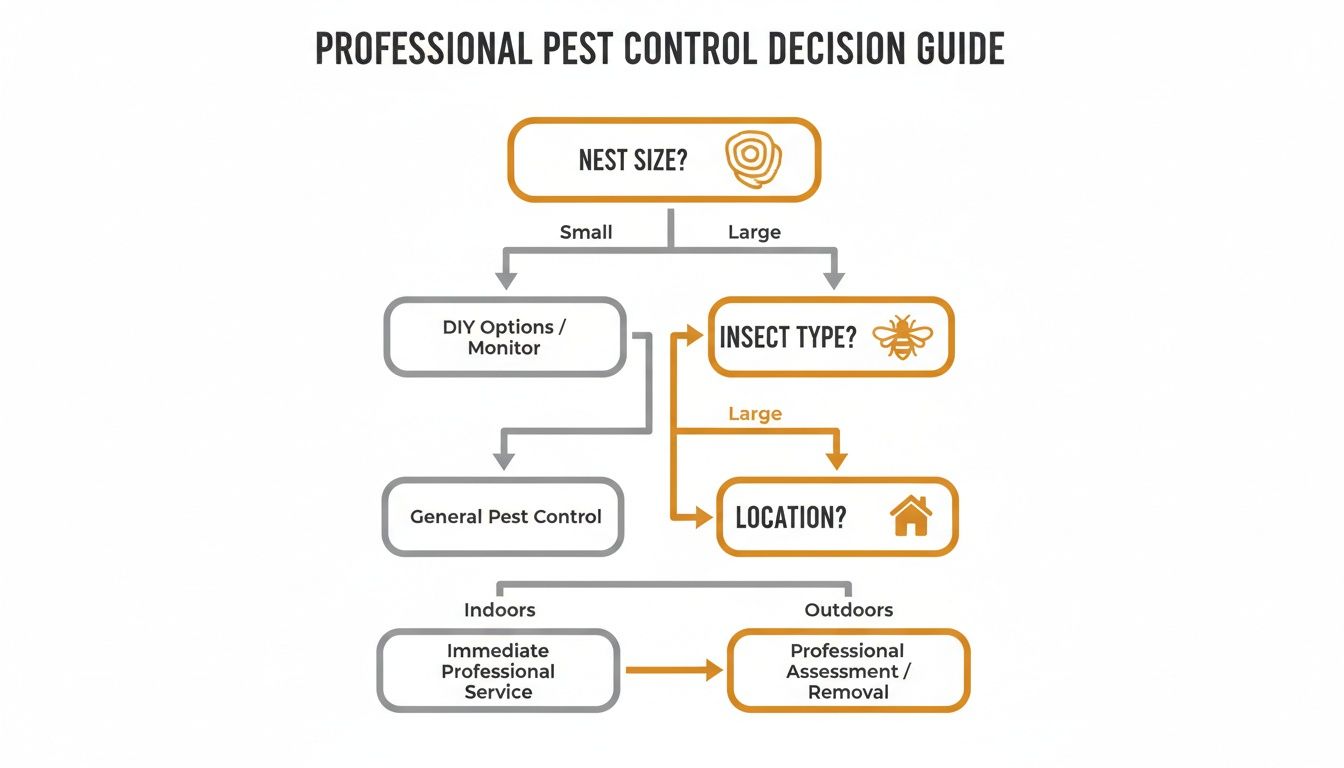
The main takeaway here is that larger nests, nests that are tough to get to, or any colony of aggressive insects should be a signal to call in an expert.
While these prevention tips are highly effective, an established nest is a different challenge. Attempting to remove a mature wasp colony on your own can provoke an aggressive swarm, putting you at risk of multiple stings.
For a deeper dive into making your property a no-fly zone, you can learn more about how to prevent wasp nests on our blog.
If you've already spotted a nest or have a persistent wasp problem, don't wait. Contact Dragon Pest Control today for safe, professional removal and peace of mind.
Common Questions Answered
When you're dealing with stinging insects, a lot of questions pop up. As the local experts on the honey bee vs. wasp situation here in Alberta, we’ve put together answers to the most common things homeowners ask us. This should help you make safe, smart decisions when you find bees or wasps on your property.
What Should I Do If I Find a Swarm of Bees?
If you spot a big, buzzing cluster of bees on a tree branch or the side of your house, you're most likely looking at a honey bee swarm. Don't panic. They aren't usually aggressive in this state—they're just taking a breather while scout bees look for a new, permanent home.
The best thing you can do is keep your distance and call a local Red Deer beekeeper. Beekeepers are often happy to come and collect a swarm for free to help start a new hive. Whatever you do, never spray them; these pollinators are crucial for our local ecosystem.
Are Paper Wasps as Dangerous as Yellow Jackets?
While both can sting you more than once, there’s a big difference in their attitude. Paper wasps tend to keep to themselves unless you directly threaten their open, umbrella-shaped nest. Otherwise, they're relatively passive.
Yellow jackets, on the other hand, are a different story, especially the ones that nest underground. They are extremely territorial and will launch a full-on swarm attack if you so much as walk too close to their hidden nest entrance.
A key takeaway in the honey bee vs. wasp debate is that nearly all common wasp species in Alberta, including paper wasps and yellow jackets, can sting you repeatedly. Honey bees can't.
Why Do Wasps Get So Aggressive in Late Summer?
By the time summer starts to wrap up, a wasp colony is at its absolute peak, with thousands of hungry workers to feed. At the same time, their natural food sources like caterpillars and other bugs begin to dry up.
This combination of a massive population and a food shortage turns them into desperate, bold scavengers. It's exactly why they become such a nightmare at picnics and backyard BBQs in August and September.
If you've found a wasp nest or are dealing with aggressive stinging insects, don't put yourself at risk. Contact Dragon Pest Control for a professional and guaranteed solution. Book your service online today.