

Dealing with mice isn't just about setting a few traps. It's a multi-pronged attack: you have to find them, block their way in, cut off their food supply, and then trap them. This is the exact strategy we use because it's the only one that truly works to get rid of mice for good and keep them from coming back.
Is That a Mouse I Hear Squeaking?
It almost always starts small. A quiet scratching from inside a wall late at night. A tiny, dark speck on the floor you write off as lint. But before you can really tackle a mouse problem, you need to confirm that's what you're dealing with and figure out how big the issue is. Ignoring these little clues is a huge mistake—there’s no such thing as just one mouse.
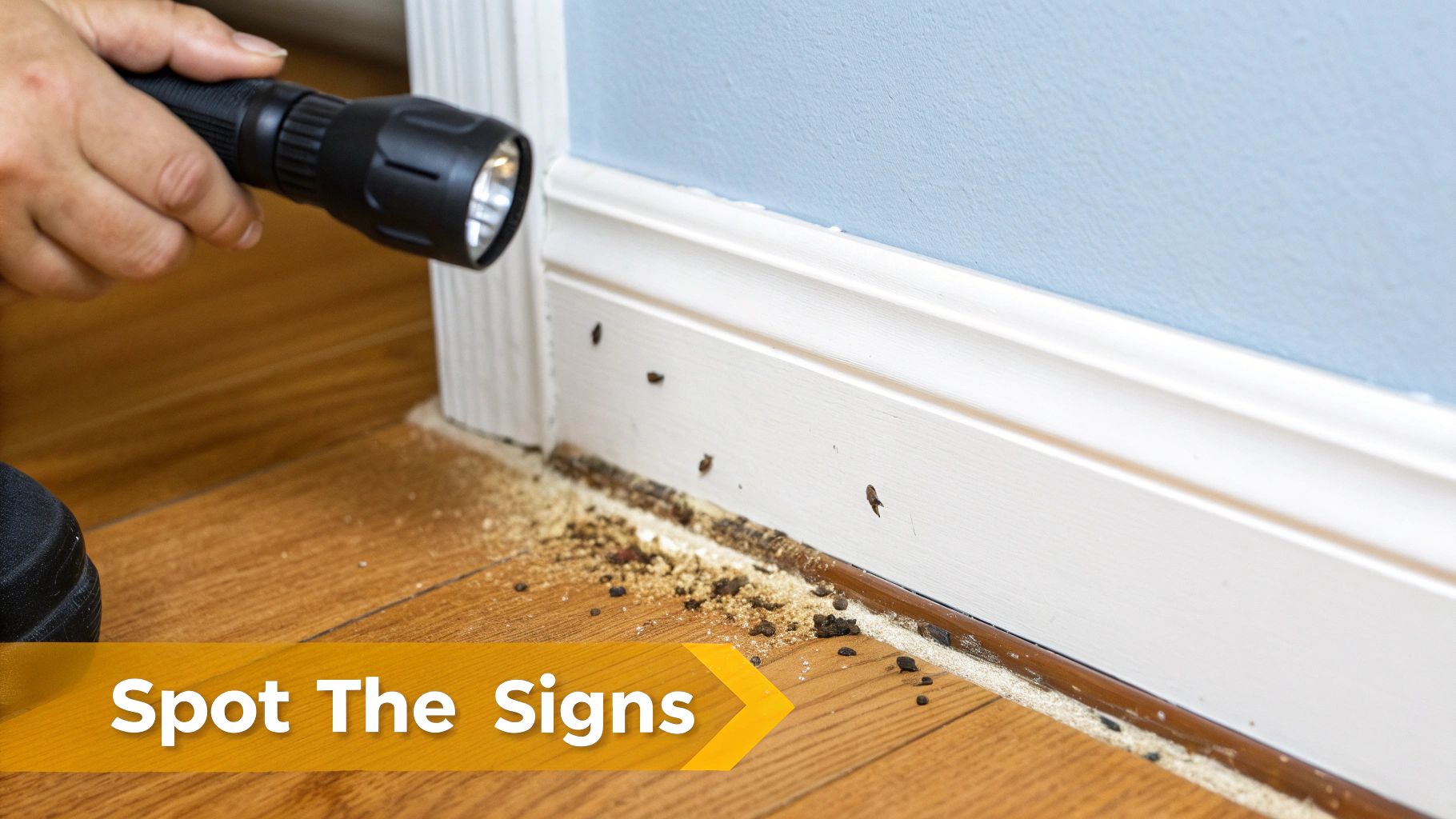
These rodents are masters of hiding, which means you have to become a bit of a detective in your own home. Learning to spot the not-so-obvious signs is the key to stopping a minor nuisance before it becomes a major headache.
Look for More Than Just Droppings
Droppings are the classic sign, sure, but they’re far from the only clue mice leave behind. A proper inspection means using your eyes, your nose, and even paying attention to how your pets are acting.
Keep an eye out for these tell-tale signs of mouse activity:
- Greasy Rub Marks: Mice have oily fur and stick to the same routes over and over, usually hugging walls and baseboards. This leaves behind dark, greasy smudges on those surfaces.
- Gnaw Marks: A mouse's front teeth never stop growing, so they're constantly chewing to wear them down. Look for small, tell-tale gnaw marks on wood trim, furniture, plastic containers, and especially electrical wires.
- Distinctive Odours: A persistent, musky smell—a bit like stale urine—is a dead giveaway you have an established mouse family. The odour comes from their urine and nesting materials and is usually strongest in enclosed spaces like cupboards or closets.
- Unusual Pet Behaviour: If your cat or dog suddenly becomes obsessed with a spot under the dishwasher or behind the fridge, trust their instincts. Their sharp senses can often detect rodents long before we can.
Identifying the Evidence
Finding evidence is one thing; knowing what you're looking at is another. It's easy to mistake mouse droppings for signs of other, larger pests. Mouse droppings are tiny (about 3-6 mm long), dark, and pointed at both ends, looking a lot like grains of black rice. Rat droppings, on the other hand, are much bigger with blunt ends.
A single house mouse can produce between 40 and 100 droppings per day. Finding even a few is a clear signal that you have active rodents exploring your home for food and a place to live.
Beyond the obvious signs like squeaking, a mouse infestation has a real impact on your home's indoor air quality. Their droppings, urine, and dander can get into the air, spreading allergens and contaminants that you and your family breathe in.
Your Home Inspection Checklist
To really understand the scope of the problem, you need to check the places where mice are most likely to hide out and build nests. Grab a good flashlight and start methodically checking these hotspots:
- Kitchen: Get down on the floor and look behind and under the stove, refrigerator, and dishwasher. Pull everything out from under the sink and check the back of those lower cabinets.
- Pantry: Inspect shelves for chewed-up packaging and droppings. Mice love getting into stored grains, cereals, and pet food.
- Basement and Attic: Check corners, behind stored boxes, and along the edges of your insulation. Mice adore shredding soft materials like insulation and cardboard to make their nests.
- Garage: Look around vehicles, on shelving units, and check any stored bags of pet food, birdseed, or grass seed.
By systematically searching these areas, you’ll pinpoint the hotspots of activity. This is crucial information that will tell you exactly where to place your traps and focus your clean-up efforts.
If you’re still not sure what pest you’re up against, our extensive pest library is a great resource for identifying all sorts of household intruders. Once you've confirmed it's mice, you’re ready for the next critical phase: sealing up your home.
Fortifying Your Home Against Tiny Intruders
Setting traps is a good start, but it's only half the battle. If you want to get rid of mice for good, you can't just keep catching the ones that get in; you have to stop new ones from taking their place. This means turning your home from a welcoming rest stop into an impenetrable fortress.
To win this fight, you have to think like a mouse. These little guys are incredible escape artists, able to flatten their bodies and squeeze through a hole the size of a dime. That tiny gap you've been ignoring around the air conditioning line? To a mouse, it's a wide-open front door.
A Room-By-Room Inspection Guide
Effective exclusion work is all about being thorough. You need to be systematic. Grab a good flashlight and a notepad, and get ready to inspect your home from top to bottom. You're looking for any gap a determined mouse could exploit.
Your Exterior Checklist
- Foundation and Siding: Walk the entire perimeter of your home, paying close attention to where different materials meet. Look for cracks in the foundation, gaps where the siding meets the concrete, and any openings around utility entry points for gas, hydro, and water.
- Doors and Windows: Check the weather stripping on all your exterior doors—and don't forget the garage. If you can see daylight peeking under a door, a mouse can absolutely get through. Make sure your window screens are in good repair and fit snugly in their frames.
- Roof and Eaves: Look carefully where your roofline meets the house. Gaps in the soffits, fascia, and around vents are common weak spots. Mice are excellent climbers and will happily use overhanging tree branches as a bridge straight to your roof.
Your Interior Hotspots
- Kitchens and Bathrooms: The dark, cluttered space under the sink is a classic entry point. Check around every single pipe that enters through the wall. You should also pull out your stove and refrigerator to inspect for hidden holes behind them.
- Utility Rooms and Closets: Pay close attention to where plumbing, electrical wiring, and ductwork enter the room. These installations are often messy, leaving large, unsealed gaps that are perfect for rodents to sneak through.
Choosing the Right Materials for Sealing
Not all sealing materials are created equal, and mice will make short work of the wrong ones. They have no trouble chewing through soft materials like wood, rubber, plastic, and especially low-grade spray foams or caulks.
Pro Tip: Never rely on expanding spray foam by itself. Mice will chew right through it in a matter of hours. Worse, they'll often use the shredded foam for nesting material. It’s a temporary fix, at best.
To create a lasting barrier, you need to use materials that mice either can't or won't chew through.
- Steel Wool: This is perfect for stuffing into small holes and gaps, particularly around pipes. The coarse fibres irritate their teeth and act as a powerful deterrent.
- Copper Mesh: A bit more durable and rust-resistant than steel wool, copper mesh is a fantastic choice for areas that might get damp, like under a kitchen sink.
- Hardware Cloth (Steel Mesh): Ideal for covering larger openings like vents. Use a sturdy ¼-inch wire mesh to block access without restricting airflow.
- High-Quality Sealant: Once you've filled a gap with steel wool or copper mesh, you need to seal over it. A good quality silicone or polyurethane caulk will hold the mesh in place and create a final, airtight barrier.
This strategy isn't just a recommendation—it's a proven tactic. Studies consistently show that a huge portion of household rodent problems are directly linked to poor housing conditions and easy entry points. Sealing openings larger than 6 mm (about the width of a pencil) is known to dramatically reduce mouse entry. In fact, comprehensive programs that combine sanitation with structural repairs report significant drops in repeat pest control calls, sometimes by double-digit percentages. It's clear proof that being proactive gets real results.
Mice don't just use obvious holes; they can also exploit hidden pathways inside your walls. To block these routes and further fortify your home, it's a good idea to learn how to seal ductwork effectively.
Creating Your Fortress, Step-By-Step
Once you’ve found all the weak points and gathered your materials, it's time to get to work. Start by cleaning any dust or debris from the cracks you plan to seal. This ensures the caulk will form a strong, lasting bond.
For smaller gaps around pipes or wiring, use a screwdriver to tightly pack steel wool or copper mesh into the opening. Then, apply a generous bead of high-quality caulk over the top to lock it in place. If you're dealing with larger holes in drywall or your foundation, you may need to patch them with the appropriate materials first before sealing the final gaps.
Sealing up your home is easily the most critical—and labour-intensive—part of mouse control. But it’s the absolute foundation of a long-term solution. It’s the difference between trapping an endless stream of new invaders and finally achieving a truly mouse-free home.
Choosing Your Tools Traps and Baits That Work
Now that your home is sealed up tight against new visitors, it's time to deal with the mice already bunking with you. Staring at the pest control aisle in a hardware store can feel overwhelming—there are so many traps, baits, and poisons. Let's cut through the noise and figure out what actually works and how to use it safely.
The classic wooden snap trap is still a go-to for a reason. It's cheap, effective, and gets the job done quickly and humanely when you set it right. Honestly, these simple devices are a must-have for any serious mouse-busting effort.
If you're looking for a more hands-off approach, modern electronic traps deliver a high-voltage shock that kills the mouse instantly and keeps it contained. There are also live-catch traps for those who'd rather not kill the animals, but be warned: they demand a lot of attention. You have to check them constantly and release any captured mice at least a few kilometres away, or they'll just find their way right back.
The Art of Trap Placement and Baiting
Here’s a secret from the pros: the type of trap you use is often less important than where you put it. Mice are creatures of habit. They have terrible eyesight, so they hug walls and baseboards, using their whiskers to navigate. Your best bet for success is placing traps right in these mouse highways.
Look for the tell-tale signs like droppings or greasy rub marks. Prime locations include:
- Along baseboards: Place the trap perpendicular to the wall, with the trigger side facing the baseboard.
- Behind appliances: The warm, dark spaces behind your fridge or stove are basically mouse freeways.
- Under sinks: Check the very back of your kitchen and bathroom cabinets, especially where the plumbing comes through the wall.
- In the attic or basement: Set traps along the perimeter walls and near any nests or gnaw marks you've spotted.
Pro Tip: Mice are naturally suspicious of new things in their territory. Try placing your traps—unset but baited—in key spots for a couple of days. Let them get comfortable taking the food. Once you see the bait disappearing, it's time to set the traps. Your success rate will skyrocket.
And forget what you've seen in cartoons. Cheese isn't the best bait. What you really want is a small dab of something high-protein and sticky. Peanut butter is the gold standard because a mouse can't just lick it off without setting off the trap. Hazelnut spread, bacon bits, or even a bit of soft pet food work wonders. If you think you're dealing with a nesting mouse, a small piece of cotton or twine can be an irresistible lure.
Choosing the right material to seal up holes is just as critical as your trapping strategy. This little cheat sheet can help you make a quick decision.
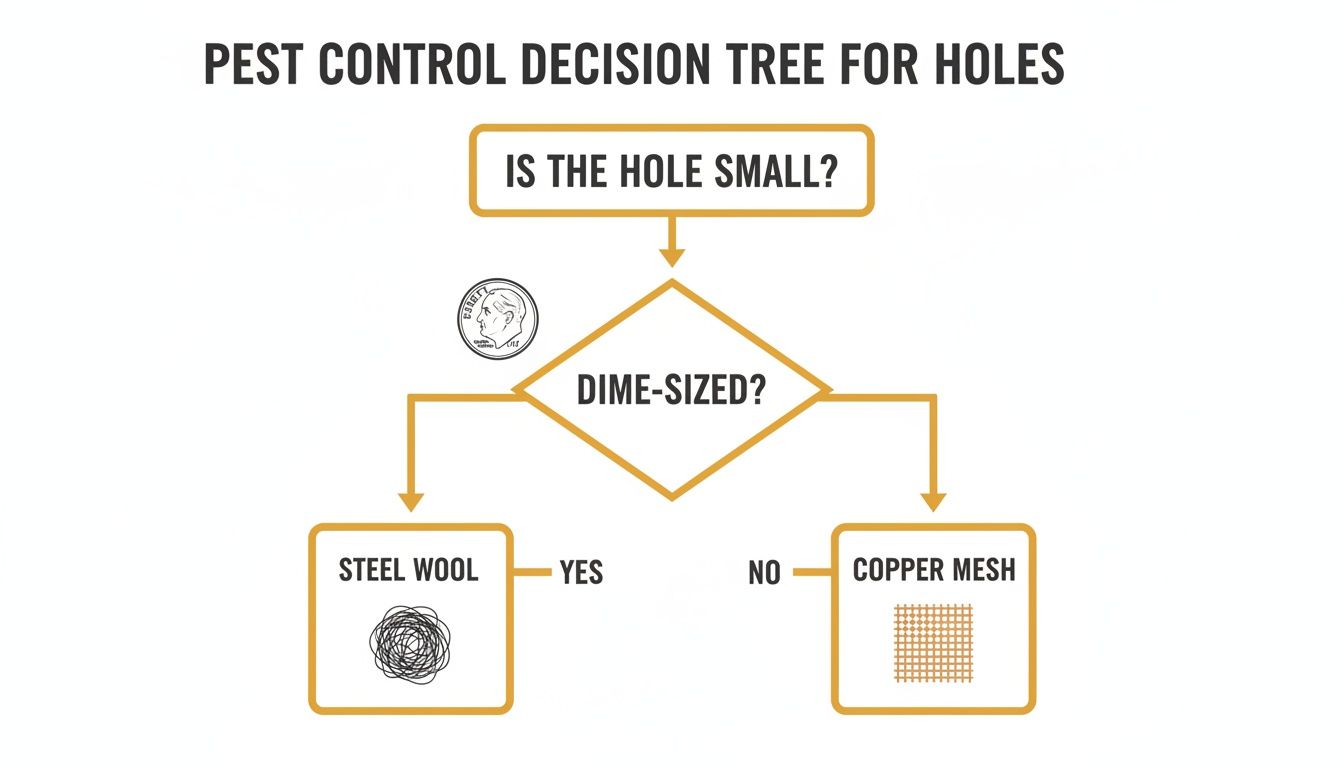
As you can see, for those tiny, dime-sized openings, a wad of tightly packed steel wool is a fantastic barrier. For bigger or more awkwardly shaped gaps, copper mesh is a great choice because it's durable, rust-resistant, and mice can't chew through it.
Picking the right trap for your specific situation is key. Some traps are better for homes with curious pets, while others offer a quick, no-fuss solution.
Comparing Mouse Trap Types Pros and Cons
| Trap Type | Effectiveness | Safety for Pets/Kids | Humaneness | Best For |
|---|---|---|---|---|
| Snap Trap | Very High | Low (can injure) | High (instant kill) | Fast, effective removal in low-traffic areas. |
| Electronic Trap | Very High | High (enclosed) | Very High (instant) | Hands-off, no-mess solution; safe for homes with kids/pets. |
| Live-Catch Trap | Moderate | Very High (no harm) | Very High (no kill) | Humane removal, but requires frequent monitoring and relocation. |
| Glue Trap | Moderate | Low (very sticky) | Very Low | Not recommended; causes prolonged suffering. |
Ultimately, the best choice depends on balancing effectiveness with the safety of your household and your personal comfort level with handling the outcome.
A Careful Look at Rodenticides
Poison baits, or rodenticides, are a tool that requires extreme caution, particularly in homes with children or pets. They are effective, but they come with some serious downsides. A poisoned mouse doesn't die on the spot; it will likely wander off and die inside a wall, leaving you with a horrific, lingering smell that's nearly impossible to get rid of.
The bigger worry is secondary poisoning. A cat or dog that eats a poisoned rodent can become incredibly sick, or even die. Because of these dangers, store-bought poisons should be your absolute last resort, and they must always be placed inside a tamper-resistant bait station. These are locked plastic boxes that let a mouse in to eat the bait but keep kids and pets out.
Frankly, if you're thinking about using chemical solutions, it's much safer to call a professional. Licensed technicians have access to different products and are trained to apply them strategically with minimal risk. We know how local mice behave and can create a plan that works without endangering your family. You can find more in-depth strategies in our complete pest management manual.
At the end of the day, a successful trapping campaign comes down to combining the right tools with smart placement and daily checks. Check your traps every day, dispose of any captured rodents safely, and reset them right away. Persistence is your best weapon for clearing out the existing population and taking back your home.
Making Your Home a No-Go Zone for Mice
Look, trapping and sealing up holes are huge parts of the puzzle. But if you want to get rid of mice for good, you have to get to the root of the problem. Your home became a target because it was a five-star resort offering free food, water, and shelter. It's time to shut it down.

This isn't just about wiping up a few crumbs. Real, effective sanitation means changing the small, everyday habits you might not even notice—the same habits that send an open invitation to every mouse in the neighbourhood.
Cutting Off the Buffet
Mice have an incredible sense of smell and can sniff out a meal from surprisingly far away. Your job is to make every potential food source, inside and out, completely inaccessible.
Start by looking at your food storage with a critical eye. Cardboard boxes and flimsy plastic bags are nothing more than a minor inconvenience for a determined mouse.
- Pantry Overhaul: Get everything—flour, sugar, cereal, pasta—out of its original packaging and into hard plastic, glass, or metal containers with lids that seal tight.
- Pet Food Protocol: That big bag of dog kibble in the garage? It’s a massive welcome sign. All pet food and birdseed needs to be stored in chew-proof, sealed containers. And just as important, never leave pet food out overnight. Feed your pets, and then pick up and clean their bowls.
- Lock Down Your Rubbish: Use rubbish bins with lids that seal properly. This is non-negotiable, especially if you keep your bins in the garage.
Remember, a single mouse contaminates far more food than it ever eats. It’s spreading bacteria and pathogens everywhere it goes. Cutting off their food supply isn’t just pest control; it's a critical health and safety measure for your family.
Removing Water and Shelter
Food is just one piece of the puzzle. Mice also need water to drink and safe places to build nests. A slow drip under the sink or a cluttered corner in the basement is a perfect little mouse paradise.
First, tackle any moisture issues. Fix leaky taps, check for drips under sinks, and make sure you have good drainage around your home’s foundation.
Then, turn your attention to clutter. Basements, attics, and garages are prime real estate for mice because they offer endless hiding spots. Clearing out piles of boxes, old furniture, and general junk removes their potential nesting sites and makes your home a much less comfortable place to live.
The Critical Cleanup After an Infestation
Once you're sure the mice are gone, you’re left with the cleanup. This is not the time to cut corners. It’s about protecting your family from diseases that mice can carry, like Hantavirus and Salmonellosis, which are easily spread through their droppings and urine.
A word of caution: Never sweep or vacuum dry droppings. This sends virus particles airborne, where they can be inhaled.
Instead, follow this safe cleanup procedure:
- Air It Out: Before you touch anything, open up windows and doors for at least 30 minutes to ventilate the space.
- Gear Up: Put on a pair of non-absorbent gloves (rubber or vinyl work great) and a good-quality mask or, ideally, a properly fitted respirator.
- Soak, Don't Sweep: Generously spray the droppings and any nesting materials with a commercial disinfectant or a bleach solution (1 part bleach to 10 parts water). Let it soak for a good five minutes to neutralize the pathogens.
- Wipe and Bag: Use paper towels to wipe up the soaked droppings and debris. Immediately place the used paper towels into a plastic bag, seal it, and throw it in your outdoor rubbish bin.
- Final Disinfection: After the visible mess is gone, go back and disinfect the entire area one more time, including floors and any surfaces the mice may have walked across.
Following these steps carefully ensures you remove every trace of the infestation without putting your family's health at risk. Making your home clean and inhospitable is the final, crucial step in your plan to get rid of mice for good.
When to Put Down the Traps and Call a Pro
There’s a point in every battle with mice where your determined DIY efforts start to feel like a losing game. Recognizing that moment isn’t about admitting defeat—it's about making a smart, strategic decision to save your time, money, and sanity.
If you've sealed every crack you can find, set every trap in the hardware store, and are still finding fresh signs of an infestation, it’s time to call for backup. Trying to manage a persistent mouse problem on your own can be an exhausting uphill climb. These rodents are incredibly resilient and reproduce at a shocking rate, which means a small issue can spiral into a major infestation before you even realize it.
Signs Your Mouse Problem Is Out of Control
So, how do you know when you’ve crossed the line from a minor nuisance to a serious problem that needs a professional? There are a few undeniable red flags that signal your DIY methods just aren’t cutting it anymore. If you spot any of these, it's a clear sign to pick up the phone.
- Daytime Sightings: Mice are nocturnal. Seeing one scurrying across your floor during the day is a bad sign. It often means the nests are so overcrowded that some are being forced out to find food when they’d rather be hiding.
- Constant New Droppings: You clean up droppings in the morning, only to find a fresh batch in the exact same spot by evening. This points to a large, active population that your current trapping efforts simply aren't controlling.
- A Party in Your Walls: A faint, occasional scratch is one thing. But hearing constant scurrying, squeaking, or gnawing from within your walls or ceiling suggests a significant, well-established colony has moved in.
- Persistent Odours: A strong, musky smell of urine that you can't get rid of, even after a thorough cleaning, points to a large number of mice and potentially hidden, saturated nests.
When you see signs like these, the infestation has likely reached a critical mass where consumer-grade traps just can’t keep up with their breeding cycle.
What a Professional Technician Brings to the Fight
Calling in a licensed pest control technician isn't just about getting more traps; it’s about bringing in an expert with specialized tools, knowledge, and strategies designed to solve the root cause of the infestation for good.
A professional approach goes beyond just catching the mice you see. It involves a detailed inspection to find the hidden entry points you missed, creating a strategic plan to eliminate the entire population, and implementing preventative measures to keep them out permanently.
A trained pro understands rodent behaviour. They know exactly where to look for nests and how to interpret the subtle signs mice leave behind. They can use advanced tools like borescopes to see inside your walls without causing damage, identifying the full extent of the problem right at the source.
Furthermore, professionals have access to more effective and targeted products that aren't available to the public. They are trained to use these tools safely and strategically, ensuring the problem is handled completely without putting your family or pets at risk. For a closer look at the different approaches, explore the details of our professional pest control services.
The value of professional intervention becomes incredibly clear when infestations grow rapidly. For example, during a recent rodent surge in California, one pest operator saw their calls jump from 20 per month to over 50 per week, while local hardware stores completely ran out of traps. It’s a perfect example of how quickly a large-scale problem can overwhelm DIY capabilities. The situation was made worse by new regulations restricting certain consumer rodenticides, pushing more people to rely on licensed pros who can legally and safely apply more effective, regulated solutions. You can learn more about how widespread infestations can overwhelm communities from reports on unprecedented rodent outbreaks.
Ultimately, if your efforts aren’t getting results and the signs of mice are only getting worse, calling a pro is the fastest and most effective way to reclaim your home.
Common Questions About Getting Rid of Mice
When you're in the thick of a battle with mice, questions always come up. It's easy to get conflicting information online or just feel unsure if you're doing the right thing. Let's clear the air and get you some straight answers to the most common questions we hear from homeowners.
Do Ultrasonic Repellents Actually Work?
It’s a tempting idea, isn't it? Just plug in a little device and magically drive pests away with sound. Unfortunately, the evidence just isn't there.
While mice might be startled by the sound at first, they get used to it very quickly—especially when a warm, sheltered home with plenty of food is on the table. Most independent studies show these devices have little to no long-term effect on rodent populations. Your money is far better spent on proven methods like sealing entry points and using effective traps.
Can You Really Have Just One Mouse?
This is probably the single biggest misconception in pest control. If you see one mouse, it's a virtual guarantee there are more you don't see. A single female mouse can have up to 10 litters a year, with an average of five or six pups in each litter. Those pups are ready to have their own babies in as little as six weeks.
A small mouse issue can become a major infestation in a matter of months. Never assume you're dealing with a lone wolf; act as if a whole family has moved in, because they probably have.
That rapid breeding cycle is exactly why a swift, thorough approach is so critical. The goal is to get ahead of their population growth, not just react to the one you happened to spot darting across the kitchen floor.
How Long Does It Take to Get Rid of Mice?
The honest answer? It depends. The timeline for getting a mouse problem under control hinges on a few key factors:
- The size of the infestation: Are you dealing with a new family that just moved in, or a multi-generational colony that's been there for a while?
- The thoroughness of your exclusion work: How well have you sealed off every single potential entry point? A missed gap is an open invitation.
- The consistency of your efforts: Are you checking traps daily and keeping all food sources totally locked down?
For a minor issue where you've successfully sealed the home, you might have it sorted within a week. But for a more established problem, it could easily take several weeks of consistent trapping to clear out the entire population. Patience and persistence are everything.
If you're still catching mice after a few weeks of diligent effort, that's a strong signal you've either missed an entry point or are dealing with a much larger infestation than you realized. That's often the point where calling in a professional becomes the most effective and least stressful path forward.
Don't let a mouse problem get out of hand. For a guaranteed, professional solution tailored to your home, trust the experts at Dragon Pest Control. Book your inspection online today!
Article created using Outrank