Let's be honest, finding a spider in your home can be a bit startling. That eight-legged surprise can quickly turn your cozy sanctuary into a place that feels a little less comfortable. But effective pest control for spiders isn't just about getting rid of the one you spotted scurrying across the floor.
It’s about digging a little deeper to figure out why they’re coming inside in the first place. For homeowners here in Alberta, that means creating a long-term game plan that keeps them out for good—and that starts with knowing what we're up against.
Understanding Spiders In Your Alberta Home
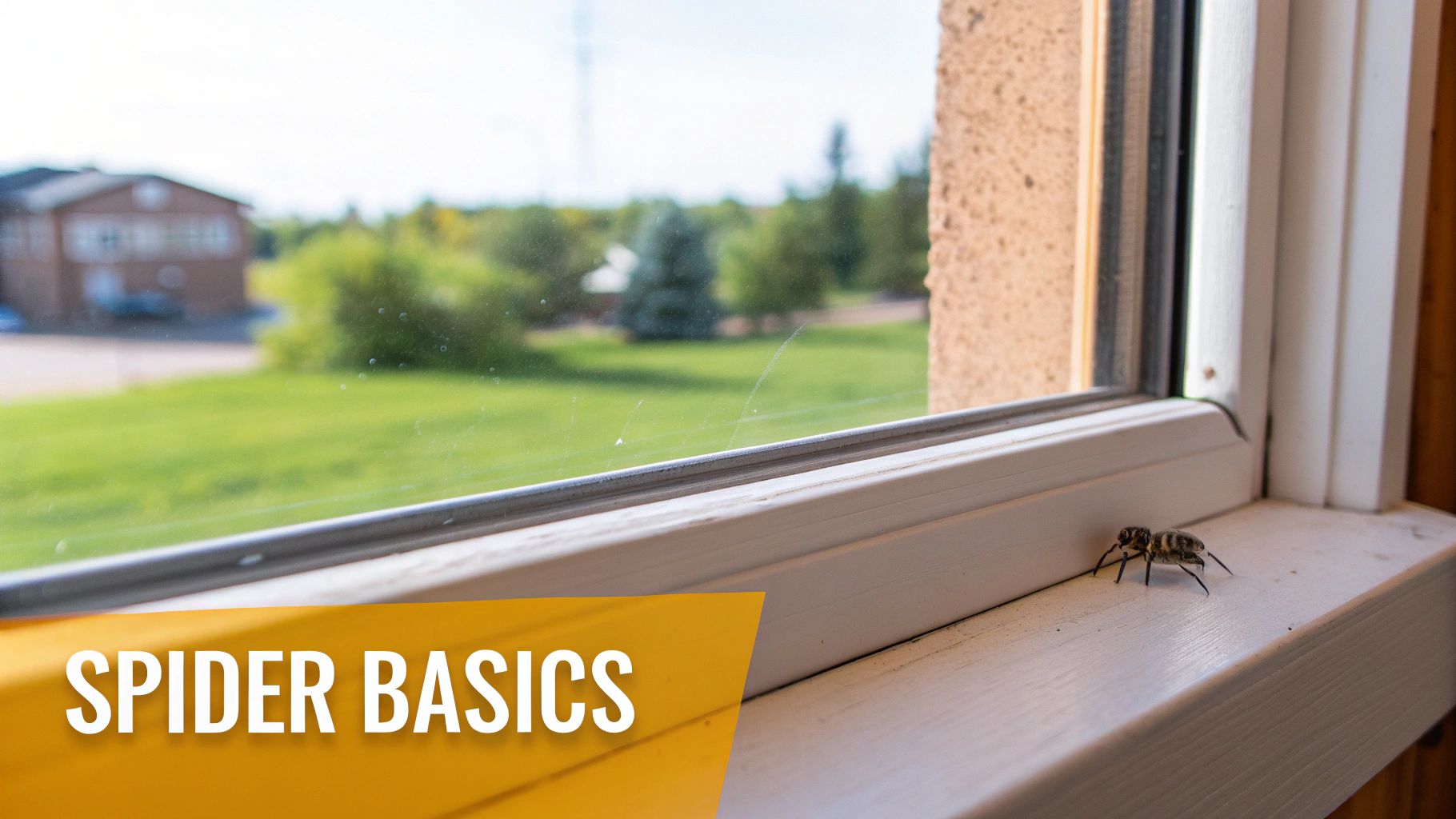
Get to Know the Spiders in Your Alberta Home
When it comes to pest control, the first step is always knowing what you’re up against. For Alberta homeowners, figuring out if a spider is a harmless visitor or something more serious is a key skill. This isn't about becoming a spider expert overnight—it's about having the confidence to know how to react when you find one.
Believe it or not, most spiders you’ll find are actually on your side. They’re nature’s own pest controllers, taking care of flies, ants, and other insects you really don't want hanging around. A healthy respect for these helpful hunters can be a big part of keeping your home’s ecosystem in balance.
To make identification easier, here's a quick rundown of the spiders you're most likely to see in and around your home.
Common Alberta Spiders At A Glance
| Spider Species | Appearance | Common Location | Risk Level |
|---|---|---|---|
| Common House Spider | Yellowish-brown with mottled markings; about the size of a nickel. | Corners of rooms, basements, window frames (look for messy, tangled webs). | Low |
| Wolf Spider | Large, hairy, and greyish-brown; can be up to 35 mm long. | Ground level, often in basements, garages, or along foundations. They hunt, so no webs. | Low |
| Black Widow Spider | Female is glossy black with a distinct red hourglass on her underside. | Dark, undisturbed areas like woodpiles, sheds, cluttered garages, and under decks. | High |
This table should give you a good starting point. Now, let's dive a little deeper into what to look for.
Harmless But Unwelcome Houseguests
The vast majority of spiders you'll meet are completely harmless to people and pets. They might give you a startle, but they don't pose any medical threat. Getting to know them is the best way to keep your peace of mind.
- Common House Spider (Parasteatoda tepidariorum): If you've got messy, tangled webs in the corners of your basement or window frames, this is likely your culprit. They're typically yellowish-brown and prefer to stay out of sight, so you'll probably see their handiwork before you see them.
- Wolf Spider (Family Lycosidae): Big, hairy, and fast. The Wolf Spider looks intimidating, but it’s all for show. These spiders are hunters who chase down their prey instead of building webs. You’ll usually spot them on the move at ground level, often in basements and garages.
These guys are classic nuisance pests. You don't want them around, but they aren't going to cause any harm.
Medically Significant Spiders to Watch For
While it’s not common, Alberta is home to a few spiders whose bites can be medically significant. Being able to identify them is crucial for your safety.
The key is not to panic. Medically significant spiders aren't aggressive and usually only bite if they're trapped or pressed against your skin.
The main one to know in Alberta is the Black Widow (Latrodectus species).
- Appearance: It's the female you need to recognize. She's glossy black and has a very obvious, bright red hourglass shape on the underside of her belly.
- Habitat: Black Widows love dark, quiet spots where they won't be disturbed. Think woodpiles, sheds, cluttered garages, crawl spaces, and underneath your deck.
- Webs: Their webs are messy, irregular, and surprisingly strong. You'll usually find them built close to the ground.
If you think you've found a Black Widow, do not handle it. Their bite contains a neurotoxin that can cause serious pain and requires medical attention. This is a clear sign that it’s time to stop any DIY efforts and call in a professional pest control service. Knowing who's who in the spider world lets you assess the situation and choose the right plan of attack.
Proven Methods For Spider Prevention
When it comes to spiders, the best defence is a good offence. The most effective strategy isn't chasing them around after they've already moved in; it's about making your home an uninviting fortress they can't breach in the first place. Think of your house like a castle—you want to seal the walls and manage the surrounding landscape, not just fight the odd intruder who finds a way inside.
For those of us in Alberta, this means adopting a preventative mindset that works with our distinct seasons. A few simple, consistent habits can make a huge difference in how many eight-legged visitors you see. It all boils down to looking at your home from a spider's perspective and taking away the three things they're always after: food, shelter, and an easy way in.
This quick visual guide breaks down the common spiders you might find, helping you figure out what you're dealing with.
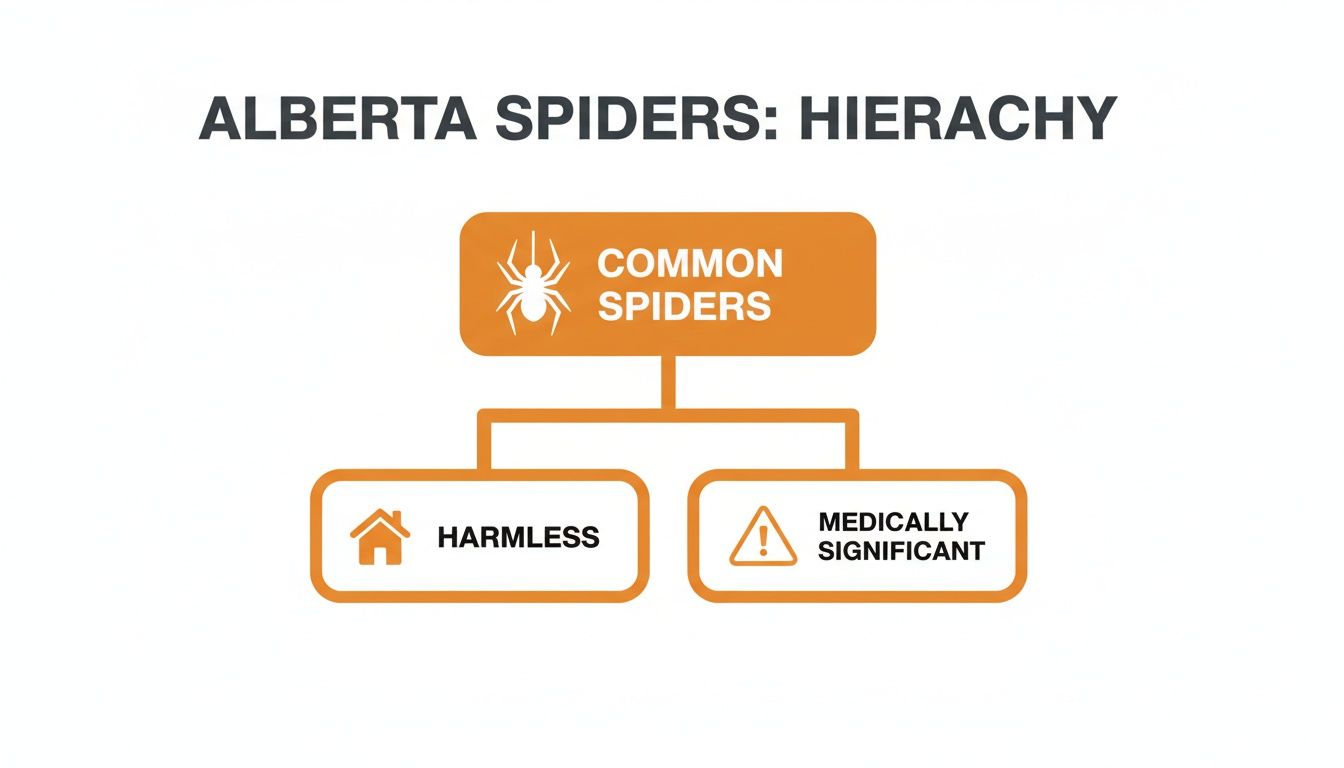
As you can see, the vast majority of spiders are harmless garden helpers. Still, knowing how to spot the few medically significant ones is a smart part of any prevention plan.
Seal Entry Points And Fortify Your Home
Spiders are master infiltrators. They can squeeze through the tiniest cracks and gaps you wouldn't even notice. Your first line of defence is to do a thorough inspection of your home's exterior and seal off these potential superhighways. This process, which we call exclusion in the industry, is the absolute cornerstone of long-term spider prevention.
Start at the foundation and work your way up. Look for cracks—no matter how small—and fill them with a quality caulk or sealant. Pay extra close attention to where utility lines, pipes, and vents enter your house, as these are notoriously common weak points.
Next, turn your focus to your windows and doors.
- Repair Screens: Check every single window and door screen for rips or holes. Even a tiny tear is a wide-open invitation for spiders and all the insects they love to eat.
- Install Door Sweeps: Fit sweeps on the bottom of all your exterior doors. This closes that annoying gap between the door and the threshold that pests love.
- Check Weather Stripping: Make sure the weather stripping around your windows and doors is in good shape and creates a tight seal when they’re closed.
Our professional inspections consistently find that 70% of entry points are tiny cracks in the foundation and gaps around windows. Just sealing these weak spots can cut down on spider sightings by up to 60%—that’s how much of a difference these simple fixes can make.
Manage Your Exterior Environment
Your yard can either be a protective buffer zone for your home or a five-star resort for pests. Spiders are naturally drawn to properties that offer plenty of food (other insects) and places to hide. By tidying up your outdoor space, you make it far less appealing to them.
An overgrown or cluttered yard is basically a playground for spiders, offering endless hiding spots. That's why regular yard maintenance is one of the most powerful tools in your spider-prevention arsenal.
The immediate habitat has the biggest influence on which spiders we find. Grassy strips and cluttered areas are vital refuges, especially for larger, free-hunting spiders. By managing these spaces, you disrupt the ecosystem that supports a large spider population.
Here’s a quick checklist to make your yard less spider-friendly:
- Trim Vegetation: Keep your grass mowed and trim back any shrubs, trees, or vines that are touching the side of your house. These act like "bridges" that spiders use to get right up to your walls and windows.
- Relocate Woodpiles: If you have a woodpile, make sure it’s at least 20 feet away from your foundation. It also helps to get it up off the ground if you can.
- Clear Debris: Regularly rake up and remove leaf litter, grass clippings, and other organic debris from around your foundation.
Reduce The All-You-Can-Eat Buffet
Finally, never forget that spiders go where the food is. If your home is surrounded by other insects, it’s like ringing a dinner bell for every hungry arachnid in the neighbourhood. One of the biggest things that attracts insects is your exterior lighting.
Your standard white light bulbs are incredibly attractive to moths, flies, and other nocturnal bugs. By making one simple change, you can seriously reduce the spider food supply right outside your doors.
Try switching your outdoor bulbs to yellow "bug lights" or sodium vapour lights. These give off a wavelength of light that is much less visible and attractive to most insects. This single change can drastically cut down on the nightly swarm around your doors and windows, which encourages spiders to set up their webs somewhere else. For more great ideas, check out our guide on DIY pest prevention tips.
When DIY Spider Control Is Effective
Trying to solve a spider problem on your own can be satisfying, but you need to know which DIY methods actually work and which are just old wives' tales. Before you grab a generic can of bug spray, it's worth understanding the limits of home remedies. This will save you a whole lot of time, money, and frustration down the road. The goal is to pick a safe, realistic approach that fits the size of your spider problem.
Most DIY spider control efforts are really just for managing the odd, one-off spider—not a full-blown infestation. Think of it as first aid versus major surgery. Simple, direct methods are great for dealing with the one or two spiders that wander inside, but they don’t get to the root of why they’re coming in to begin with.
Physical Removal And Trapping
The most direct DIY approach is simply removing the spider. This is your go-to when you spot a lone arachnid and just want it gone, right now. These methods are non-toxic and work perfectly for minor issues.
- Vacuuming: This is hands-down the quickest and cleanest way to get rid of both spiders and their webs. Use a hose attachment to get into corners, behind furniture, and along the baseboards. A huge bonus here is that you’re also removing egg sacs, which stops the next generation before it even starts.
- Sticky Traps: Also known as glue boards, these are fantastic for monitoring and catching ground-level hunters like Wolf Spiders. Lay them flat along walls in low-traffic areas like the basement, garage, or behind appliances. They work by simply catching any spider that happens to walk across them.
These physical methods are very effective for what they are: reactive tools for removing individual spiders. But if you find yourself constantly vacuuming up webs or your traps are always full, that’s a clear sign you’ve got a bigger issue that needs a more thorough solution.
Natural And Chemical Deterrents
Many homeowners reach for natural deterrents or store-bought sprays first. While some can have a little success, their effectiveness is often spotty and rarely provides a real, long-term fix for spider pest control.
Peppermint oil is a popular natural repellent. The idea is that spiders hate the strong smell and will steer clear of it. You can mix a few drops with water and spray it around windows and doors. It might deter a spider from crossing a freshly sprayed line, but the oil evaporates fast and needs to be reapplied constantly to have any effect at all.
Over-the-counter pesticides might seem like a powerful fix, but they often provide a false sense of security. These sprays only kill spiders that are directly contacted and do little to prevent new ones from arriving. Furthermore, they don't address the other pests that are attracting spiders to your home.
At the end of the day, DIY methods are most effective for low-level spider activity. When you see the occasional house spider or need to clean up a few webs, these tactics are perfect. They’re a key part of keeping your home clean and uninviting to pests. This approach aligns with the principles of Integrated Pest Management, where simple, low-impact solutions are the first line of defence. To better understand this layered strategy, you can learn more about Integrated Pest Management and how it creates lasting results.
Knowing When To Call A Professional
Those do-it-yourself spider control methods can be great for wrangling the odd eight-legged visitor that gets lost and wanders inside. But some situations escalate quickly, shifting from a small nuisance to a real problem that needs a professional touch. Knowing when you've crossed that line is key to keeping your home and family safe.
Think of it this way: you can probably fix a dripping tap with a wrench and a quick YouTube tutorial. But when a pipe bursts, you call a plumber—no questions asked. The same logic applies to pest control. When you're dealing with a persistent or potentially hazardous spider issue, the safest and most effective move is to call for backup.
Red Flags That Signal A Deeper Problem
There are a few tell-tale signs that your spider issue has gone beyond what store-bought traps and peppermint oil can handle. These red flags point to a more established population that DIY tactics just won’t be able to solve. If you spot any of these, it’s a clear sign to get some expert help.
- Recurring Sightings: You’ve cleaned, sealed every crack you can find, and put out traps, but you're still seeing spiders almost every day. This kind of persistence usually means there’s a hidden nest or a steady stream of them finding their way in from a nearby source.
- Multiple Egg Sacs: Finding one egg sac is a little unsettling, but stumbling upon several is a clear indicator of an active, breeding population. A single sac can hatch hundreds of spiderlings, and it's nearly impossible to find and remove them all on your own.
- A Sudden Increase in Webs: If you suddenly notice a huge jump in web-building activity around your property, especially inside, it’s a strong sign that the spider population is growing fast.
The most serious red flag, of course, is spotting a medically significant spider. If you think you've found a Black Widow, do not try to handle it. It’s simply not worth the risk. A licensed technician has the proper training and protective gear to manage dangerous pests safely and correctly.
The Limits Of DIY And The Professional Advantage
DIY methods are fantastic for general upkeep, but they really fall short when you need to get to the root cause of a stubborn infestation. Those over-the-counter sprays only take care of the spiders you can see, and they don't have any lasting effect to stop new ones from marching right in. This is why so many people get stuck in that frustrating loop of spraying, only to see more spiders appear a few days later.
A professional service like Dragon Pest Control brings a more strategic game plan to the table. We don't just treat the symptoms; our technicians dig in to find and eliminate the source of the infestation. We use professional-grade products to create a protective barrier around your home's exterior, getting rid of the spiders already inside and preventing new ones from getting in.
The data backs this up. In areas with high pest activity, properties without professional treatment see pests return within three months 75% of the time. In contrast, professional interventions like perimeter treatments can prevent 85% of entries and offer genuine, long-term protection. When you feel overwhelmed, the smartest move is to bring in someone who understands spider behaviour and has the right tools for the job.
For a closer look at our methods, you can read about our effective pest control solutions in Red Deer.
The Dragon Pest Control Treatment Process

When you decide to call in a professional, you’re doing more than just buying a service. You're trusting us to protect your home. At Dragon Pest Control, we take that responsibility to heart. Our entire process is built on being thorough, safe, and always keeping you in the loop, so you know exactly what’s happening from start to finish.
Think of it like a doctor’s visit for your house. We don’t just show up and start spraying a generic solution. We start with a full diagnosis to figure out what makes your property unique and what’s really going on with your spider problem.
This means every client in Red Deer and central Alberta gets a solution that’s actually designed for their situation, not some one-size-fits-all approach. Let's walk through the steps our licensed technicians take to give you back your peace of mind.
Step 1: Comprehensive Property Inspection
The first step is always the most important. One of our licensed Dragon Pest Control technicians will do a deep dive, inspecting your entire property, inside and out. We're not just looking for spiders; we’re hunting for the why.
Our technicians are trained to think like pests. They’re skilled at spotting the conditions that draw spiders in and the tiny entry points they sneak through to get inside your home. This initial assessment becomes the blueprint for our entire strategy.
Here’s a look at what’s on our checklist:
- Active Infestation Sites: We pinpoint exactly where spiders are living and breeding right now.
- Potential Entry Points: We identify cracks in the foundation, gaps around windows, and where utility lines enter the house.
- Conducive Conditions: We take note of things like excess moisture, exterior lighting, or nearby plants that attract spiders and their insect prey.
Step 2: A Customized Treatment Plan
Once the inspection is done, we build out your customized treatment plan. This is where our expertise really comes into play, as we choose the most effective and safest methods for your specific situation. We’ll explain everything we recommend, so you understand what we’re doing and why it works.
Our plan doesn’t just deal with the spiders you see now; it targets the root causes that led to the problem in the first place. Our goal is a lasting solution, not just a quick fix.
Your custom plan is a multi-layered strategy. It combines targeted interior treatments to deal with existing spiders and a powerful exterior barrier to block new ones from ever getting in. This integrated approach ensures we solve the current issue while protecting your home from future invasions.
We rely on professional-grade products that are tough on spiders but applied with the utmost care for your family and pets. Our technicians focus on the cracks, crevices, and hidden voids where pests hide, minimizing any exposure in your main living areas.
Step 3: Professional Treatment and Follow-Up
With your go-ahead, our technician gets to work. We operate efficiently and treat your home with the same respect we’d treat our own. A key part of the service is the exterior perimeter treatment, which creates an invisible shield around your foundation.
This barrier intercepts spiders before they can find a way inside, which dramatically cuts down on future sightings. Indoors, we concentrate on web removal and targeted applications in basements, crawl spaces, and other common spider hotspots.
But our job isn't done after the first visit. We’ll schedule a follow-up to make sure the treatment was effective and to tackle any new activity. This diligent follow-up is a core part of our service guarantee. If you’re not impressed with the results, it’s free. That’s the Dragon Pest Control promise, giving you complete confidence that your spider problem will be solved for good.
Your Spider Control Questions, Answered
Even with the best prevention plan, it's natural to have questions when you're thinking about calling in the pros. We get it. To give you some peace of mind, here are the most common questions we hear from homeowners across Alberta, along with our straightforward, no-nonsense answers.
Are The Pest Control Treatments Safe For My Children And Pets?
This is always the first and most important question, and the answer is a firm yes. At Dragon Pest Control, your family's safety is our top priority, full stop. Our licensed technicians are experts, trained to use professional-grade products that meet the strict safety standards set by Health Canada.
Our whole approach is about being smart and targeted. We focus on applying treatments to the cracks, crevices, and voids where spiders actually live and travel. This method is incredibly effective at getting rid of spiders while minimizing any contact with your main living areas. We’ll always walk you through the products we’re using and any simple precautions you might need to take, so you get a solution that’s both powerful and responsible.
How Often Should My Property Be Treated For Spiders?
There’s really no one-size-fits-all answer here; it all comes down to your specific situation. The best treatment schedule depends on a few key things: how bad the current infestation is, where your property is located (are you near a field or a wooded area?), and even the time of year. For an active problem, we'll typically start with an initial treatment and then schedule a follow-up to make sure we've knocked it out.
For homeowners looking for year-round peace of mind, a seasonal prevention plan is the way to go. A service in the spring helps get ahead of spiders before they really become active, and another treatment in the fall sets up a barrier to stop them from sneaking indoors for the winter. Our technicians will always recommend a custom schedule that makes the most sense for your home.
Why Am I Seeing More Spiders After A Treatment?
It can be a bit jarring, but seeing a temporary spike in spider activity right after a treatment is completely normal. In fact, it’s a great sign that the treatment is working exactly as it’s supposed to.
Think of it this way: our products are designed to flush spiders out of their deep hiding spots, like inside wall voids or behind baseboards. As they move across the treated surfaces, they're driven out into the open before they die. This burst of activity should calm down significantly within a few days.
If you’re still seeing a lot of spiders more than a week after our visit, give us a call. It’s all part of our service guarantee.
Can You Guarantee Spiders Will Be Gone For Good?
We believe in being honest: effective pest control is an ongoing management process, not a one-and-done magic trick. While our treatments are fantastic at wiping out current infestations and creating a strong protective shield, nature is persistent. New spiders can always find their way onto your property from the surrounding environment.
That’s precisely why our service is a partnership. We combine professional-grade treatments with practical prevention advice you can use all year. An ongoing maintenance plan is the most reliable, stress-free way to keep your home consistently protected. It ensures the defensive barrier around your house stays strong, stopping new problems before they even have a chance to start.
Ready to reclaim your home from spiders? The expert technicians at Dragon Pest Control are here to provide a safe, effective, and guaranteed solution designed for your home.