
When you spot a big ant confidently marching across your kitchen floor, it’s natural to feel a little uneasy. Is it just a lost wanderer, or is it a scout for a much bigger problem hiding inside your walls?
Figuring out what carpenter ants look like is the first and most crucial step in protecting your home. These aren't just your average nuisance ants; they are wood-destroying insects that can seriously compromise your home's structure over time if left unchecked.
Unlike termites, carpenter ants don't actually eat the wood. Think of them as tiny excavators. They use their powerful jaws to chew through wood, creating clean, smooth tunnels—called galleries—to build their nests. This is a key difference because the evidence they leave behind is unique. Catching them early is everything.
Key Visual Identifiers
Here in central Alberta, including Red Deer, the carpenter ants you're most likely to see indoors are pretty big. They're typically black or a mix of red and black, measuring between 6 and 13 millimetres (that's about ¼ to ½ an inch). They're one of the largest ant species you'll find in your home.
So, what should you look for?
- An evenly rounded, smooth thorax (the middle section of their body).
- A single, small bump (called a node) connecting their thorax and abdomen.
- Elbowed antennae that have a distinct bend in the middle.
- A very narrow, "pinched" waist.
That last point is the big one. Homeowners often mistake carpenter ants for termites, but the waist is the giveaway. Termites have a thick, straight body with no defined waist and their antennae are straight, not bent. The University of Minnesota Extension has some great visuals if you want to dive deeper into their anatomy.
This simple chart makes that critical distinction crystal clear.

As you can see, the pinched waist is the defining feature of any ant, while a termite's body is broad and uniform from top to bottom.
To help you feel confident in your ID, it’s always a good idea to compare features side-by-side. While size and colour are great starting points, it's the little details like the waist shape and antennae that seal the deal.
Quick Identification Carpenter Ant vs Termite vs Other Ants
Sometimes you just need a quick visual reference. This table breaks down the most important features to help you tell these common pests apart at a glance.
| Feature | Carpenter Ant | Termite | Other Common Ants |
|---|---|---|---|
| Waist | Narrow and distinctly pinched or constricted. | Broad with no defined waist between sections. | Pinched, similar to carpenter ants. |
| Antennae | Bent or "elbowed" in the middle. | Straight and often bead-like in appearance. | Also bent or elbowed. |
| Colour | Typically black, or red and black. | Creamy white to light brown. | Varies (brown, black, red, or yellow). |
| Wings (If present) | Front wings are longer than hind wings. | Both pairs of wings are of equal length. | Front wings are longer than hind wings. |
By focusing on these clear, physical differences—especially the waist and antennae—you can quickly figure out if you're dealing with a carpenter ant or something else entirely.
Alright, now that you can tell a carpenter ant from a termite, let's get into the nitty-gritty. We're going to zoom in on the finer details that the pros use to make a positive ID.
Learning these specific anatomical markers will give you the confidence to know exactly what you’re dealing with. It’s a bit like learning to spot the subtle differences between two similar car models—once you see them, you can’t miss them.
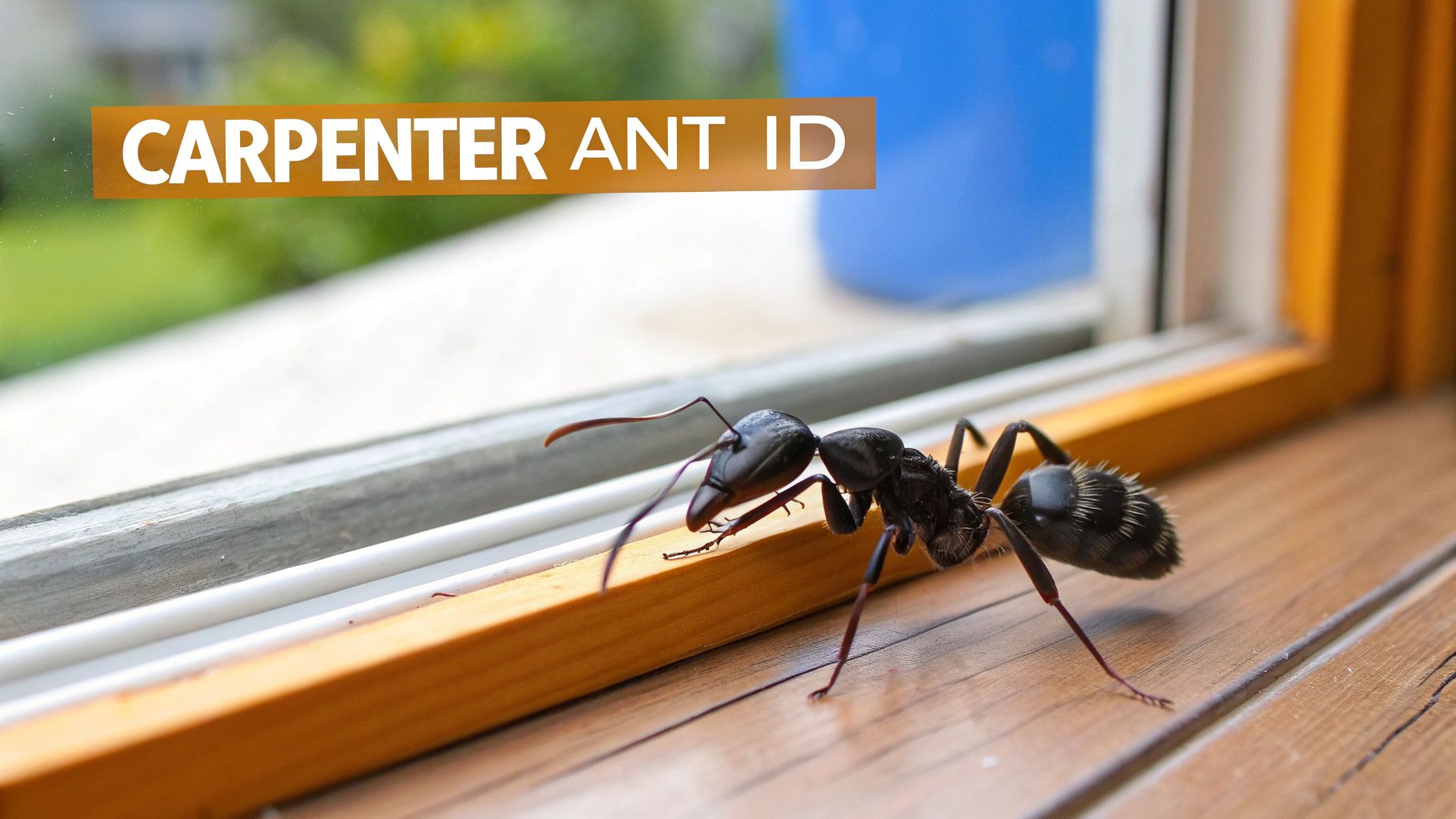
We'll focus on three key features. When you see all three together, you have a definitive profile of a carpenter ant.
The Smooth, Arched Back
First things first, take a look at the ant's midsection from the side. This part is called the thorax. On a carpenter ant, the thorax is smoothly and evenly rounded. Picture a single, continuous arch, like a gently sloping hill with no dips or bumps.
This smooth profile is one of the most reliable tell-tale signs. Lots of other common house ants have an uneven thorax with noticeable dips or even spines, making their back look jagged in comparison.
A Single-Bump Waist
Next up, check out the area connecting the thorax to the abdomen. This tiny segment, called the petiole, is what gives the ant its "waist." On a carpenter ant, this waist is made up of just one small bump, or node.
Think of it as a single small bead on a string. Other ants might have two nodes, which would immediately rule them out. That single-node waist, combined with their large size and smooth back, really narrows down the possibilities.
The combination of a smooth, arched thorax and a single-node waist is a powerful diagnostic tool. When you see both of these features on a large black or reddish-black ant, you can be almost certain it's a carpenter ant.
This specific pairing of traits is what diagnostic labs and entomologists rely on. In fact, research from institutions like Ohio State University points to a trio of identifiers: the evenly rounded thorax, the single node, and a third, more subtle clue. You can dig deeper into their findings by reading about the key characteristics of carpenter ants.
The Subtle Ring of Hairs
Finally, the last clue is a bit harder to spot without a magnifying glass, but it’s the final piece of the puzzle. At the very tip of their abdomen, carpenter ants have a small, circular fringe of hairs. This feature, known as an acidopore, is a tiny detail that confirms their identity within their specific ant subfamily.
By looking for these three specific features, you can move past a simple guess and make a confident identification.
- Evenly rounded thorax: A smooth, continuous arch.
- Single-node petiole: One small bump for a waist.
- Circle of terminal hairs: A subtle fringe at the abdomen’s tip.
When you can spot these anatomical details, you'll know precisely what the professionals are looking for when they assess a potential infestation in your home.
Identifying Winged Ants and Swarmers
Finding ants with wings inside your home can be a startling discovery. It often feels like the problem has suddenly gotten much worse—and in many ways, it has. These winged ants aren't a new species moving in; they're the reproductive members of a nearby carpenter ant colony, often called "swarmers" or "alates."

These swarmers are the future kings and queens, sent out on a mission to establish brand-new nests. Their sudden appearance is a clear signal that an existing colony is not only close by but has been thriving for several years. A colony has to be quite mature before it has the resources to produce these reproductive offspring. For homeowners in Alberta, seeing them is often the first major red flag.
What Carpenter Ant Swarmers Look Like
Carpenter ant swarmers are noticeably larger than the wingless worker ants you might see foraging in your kitchen. They still have the same core body features—the pinched waist and elbowed antennae—but with the obvious addition of two distinct pairs of wings. This is where a critical identifier comes into play.
A carpenter ant swarmer has a front pair of wings that is significantly longer than its back pair. This is a dead giveaway when compared to termite swarmers, whose four wings are all equal in length. It's a simple visual check, but it's one of the most reliable ways to distinguish between these two destructive pests.
In central Alberta, carpenter ants often make their debut in the spring when these winged swarmers emerge from hidden spots like wall cavities, attics, or decaying deck posts. The queens of our North American carpenter ant species can be impressively large, reaching up to 20 mm (about ¾ of an inch) long. This distinct difference in wing length is a primary trait used in identification keys by pest experts across the country. You can learn more about how these characteristics help identify carpenter ants on the National Park Service website.
The Evidence Swarmers Leave Behind
One of the most common signs homeowners find after a swarm is what gets left behind on windowsills, floors, or near light sources. After their brief mating flight, newly fertilized queens will shed their wings to find a suitable spot to start a new colony. The males, their job done, die shortly after.
Finding delicate, discarded wings near your windows is a telltale sign of a recent carpenter ant swarm. It confirms that reproductive activity has occurred inside or very close to your home.
This discovery is more than just a clue; it’s a call to action. It confirms the presence of a mature parent nest that is actively trying to expand its territory.
The timing of these events is also quite predictable. Swarming is a seasonal behaviour, typically triggered by warm, humid weather that follows a period of rain. In Alberta, this most often happens in the spring or early summer. When you see swarmers, you’re witnessing a critical moment in the colony's life cycle—one that directly threatens your property.
Finding the Telltale Signs of an Infestation
Seeing one big ant wander across your floor is one thing, but figuring out if you have a full-blown infestation takes a bit of detective work. You know what carpenter ants look like now, but they’re sneaky. You’re far more likely to find the evidence they leave behind than the ants themselves.
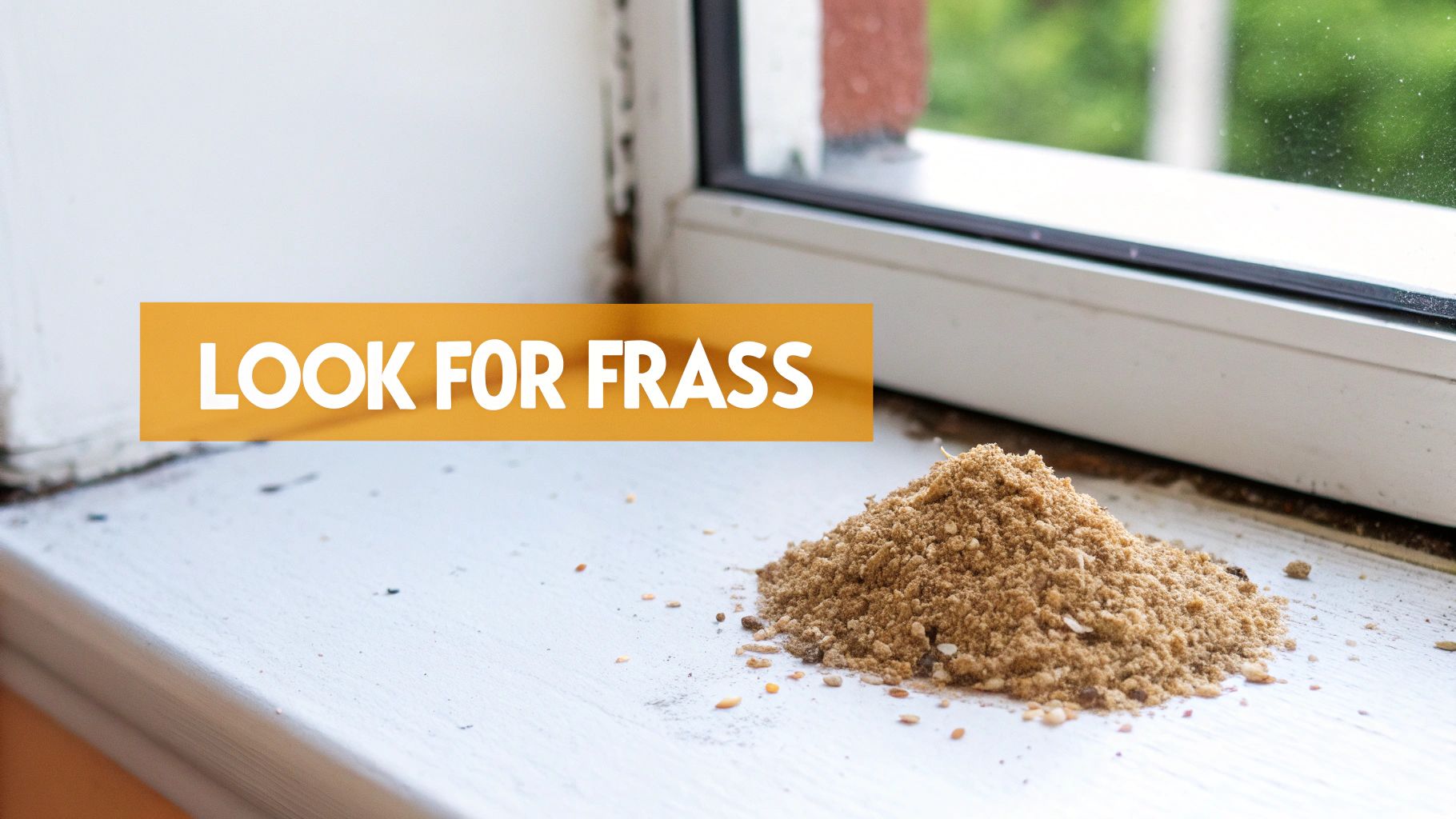
The biggest giveaway is a material called frass. Think of it as the leftover debris from their destructive construction project. Unlike termites that eat wood, carpenter ants just chew it up and spit it out, creating little piles of fine, sawdust-like shavings.
This isn't clean sawdust, though. Frass is often mixed with other junk from their nest—bits of soil, dead insect parts, and even tiny pieces of insulation. Finding these small, cone-shaped piles is a huge red flag that a nest is nearby.
Where to Look for Evidence
To find frass, you have to think like an ant. They’re looking for a safe, secure place to build, and they absolutely love wood that’s been softened by moisture. This makes certain parts of your home prime real estate.
Start your search in these common hotspots:
- Under window sills and door frames: Check the floor directly beneath them for any sawdust-like debris.
- In crawl spaces and basements: Look along the foundation walls, especially where wooden joists meet the concrete.
- Near plumbing or roof leaks: Anywhere wood has been exposed to dampness is a potential nesting site.
- Inside hollow doors or wall voids: You might notice small piles of frass appearing along the baseboards.
Finding unexplained piles of what looks like wood shavings is one of the most reliable signs you have an active carpenter ant colony. It’s the physical proof that they are excavating wood somewhere inside your home.
Ready to do a quick check yourself? This simple checklist can help you inspect your property for the most common signs of a carpenter ant problem.
Carpenter Ant Infestation Checklist
| Location to Check | Sign to Look For | Notes |
|---|---|---|
| Window Sills & Door Frames | Fine, sawdust-like piles (frass) on the floor below. | Pay close attention to corners and hidden areas. |
| Basement or Crawl Space | Damaged or hollow-sounding wood joists. | Tap the wood beams and listen for a hollow sound. |
| Kitchen & Bathroom Sinks | Small piles of frass in the cabinet under the sink. | Leaky pipes create the damp wood they love. |
| Attic & Eaves | Water-stained wood or soft, damp spots. | Check around vents and any areas with past roof leaks. |
| Exterior Foundation | Trails of ants walking along the foundation wall. | Follow the trail to see where they are entering the house. |
| Porches & Decks | Soft, rotting wood posts or floorboards. | Probe the wood with a screwdriver to check for weakness. |
After running through this checklist, you should have a much clearer picture of what's happening. If you've found any of these signs, it's a good idea to take action.
Listening for Other Clues
Beyond what you can see, other subtle signs can point to an infestation. Carpenter ants are most active at night. When your house is quiet, you might actually be able to hear them. Listen closely for faint rustling or crinkling sounds coming from inside your walls or ceilings—that’s the sound of hundreds of workers excavating their galleries.
Another clue is seeing consistent trails of foraging ants. A single scout is perfectly normal, but a steady line of them marching toward a specific spot in your home means they have a well-established highway from their nest to a food source. Addressing these signs early is key, and understanding how to get rid of ants effectively means tackling the nest itself, not just the ants you see.
How to Prevent Carpenter Ants in Your Home
When it comes to carpenter ants, the best offence is a good defence. Making your home an undesirable target in the first place is always less stressful and less costly than tackling a full-blown infestation. These strategies are all about getting rid of the conditions that attract these wood-destroying pests to begin with.
The biggest draw for carpenter ants is moisture. Why? Because soft, damp wood is much easier for them to tunnel through than dry, healthy wood. This makes water management your first line of defence. Fix any leaky pipes under sinks or in crawl spaces, make sure your gutters are clear, and check that downspouts are channelling water a few feet away from your foundation.
This proactive approach makes your home less of a magnet for pests, sending a clear signal that it's not a prime location for a new nest.
Creating a Protective Barrier
Beyond controlling moisture, you need to cut off the easy-access highways ants use to get inside. Carpenter ants are impressive climbers and will use any bridge they can find to reach your home.
Think of overhanging tree branches as a superhighway leading straight to your roof. Trimming them back so they don't touch your house is a simple but incredibly effective move. Along the same lines, store firewood and any extra building materials well away from your foundation and get them up off the ground.
A key part of prevention is removing the 'welcome mat' for pests. Sealing entry points and removing easy access routes forces them to look elsewhere for shelter.
This is all about interrupting their natural path. By creating a clear zone around your home, you make it much harder for those foraging scouts to ever find a way in.
Sealing Potential Entry Points
Finally, do a lap around your home's exterior and look for any small openings. Carpenter ants can squeeze through surprisingly tiny cracks and crevices to get inside.
Grab a quality silicone-based caulk and seal up any gaps you find around:
- Utility pipes where they enter the house
- Window and door frames
- Cracks in the foundation or siding
These straightforward maintenance tasks are a huge part of long-term protection. While these steps are powerful, sometimes a stubborn pest problem calls for a different tactic. Learning how to get rid of ants naturally can give you extra strategies to add to your prevention efforts. By making your home tough to get into and a bad place to nest, you drastically lower the risk of ever facing a destructive infestation.
When You Need a Professional Pest Control Expert
While being proactive is your best first defence, some carpenter ant problems are simply too big for a DIY approach. Knowing when to put down the spray can and pick up the phone is key to protecting your home’s structure from serious damage.
One of the biggest red flags? Seeing winged ants—or "swarmers"—inside your house. This is a sure sign that a mature, established colony is nearby and actively trying to expand its territory. Other telltale signs are discovering little piles of frass (which looks like fine sawdust) near baseboards or hearing faint rustling or crinkling sounds coming from inside your walls, especially at night. These are strong indicators of a hidden infestation you likely can't reach on your own.
The Risks of DIY Treatment
It’s tempting to grab a can of bug spray and go to town, but this can often backfire spectacularly. Many over-the-counter products will only kill the foraging ants you see, not the queen and the colony hidden away. Worse, they can cause a phenomenon called "budding," where a stressed colony splits into multiple new satellite nests throughout your home. You've just turned one big problem into several smaller—and much harder to find—ones.
A professional assessment is the safest and most effective way to handle an established carpenter ant problem. An expert has the right tools and training to locate the primary nest without tearing your walls apart, and they use treatments designed to eliminate the entire colony for good.
If an infestation feels overwhelming or you're seeing any of these advanced signs, it's usually best to get some professional help. To get a better idea of what's involved, you can explore various professional pest control services and see what they offer.
Calling in an expert isn’t giving up; it’s making a smart investment to protect your home. If you've spotted swarmers, frass, or can hear them in your walls, it’s time to consider our specialized carpenter ant control services to make sure the problem is handled correctly from the start.
Your Carpenter Ant Questions, Answered
Once you’ve spotted what you think might be carpenter ants, a lot of questions usually follow. It’s completely normal. We hear the same ones from homeowners all across Red Deer and Central Alberta, so let's clear up some of the most common concerns.
Do Carpenter Ants Actually Eat Wood?
This is the biggest misconception out there, and the answer is a simple no. Unlike termites, carpenter ants don’t eat wood for nutrition. Think of them as construction workers, not consumers.
They use their strong jaws to chew through wood, carving out smooth, clean tunnels and galleries to build their nests. That sawdust-like material you might find near baseboards or on windowsills? That's called frass, and it's just the leftover wood shavings and insect parts they've kicked out of their new home. It's construction debris, not dinner scraps.
Does Seeing One Ant Mean I Have an Infestation?
Not necessarily, so don't panic just yet. A single large ant could easily be a lone scout from a nest outside. It might just be wandering around, looking for food or a promising new spot to expand the colony.
The real red flag is consistency. If you start seeing them regularly, find ants of different sizes (workers vary), or spot winged ants indoors, that’s a different story. Those are strong signs that a nest is already set up somewhere inside your walls, attic, or very close by.
A single ant is an observation. A steady trail of them is a warning sign. The key is noticing the pattern—it tells you whether you're dealing with a lost wanderer or an organized invasion.
Can I Get Rid of Carpenter Ants Myself?
It’s tempting to grab a can of spray or set a few traps, but DIY methods rarely solve the actual problem. Most store-bought products only kill the worker ants you see foraging for food. They don’t touch the heart of the colony—the nest and the queen—which is usually tucked away deep inside a wall void or piece of insulation.
Worse, a botched DIY attempt can sometimes stress the colony, causing it to split into several smaller "satellite nests." This actually makes the infestation harder to control. A professional has the right tools and training to locate the source and ensure the entire colony is eliminated for good.
If you've spotted the signs of an active colony, don't wait for the damage to get worse. Contact Dragon Pest Control today for a professional assessment and an effective treatment plan. Book Your Carpenter Ant Inspection Online.