

Figuring out if you have a mouse or a rat problem is the first step, but here in Alberta, the answer is almost always the same. Mice are small, curious, and unfortunately, very common in our homes. Rats, on the other hand, are much bigger, more cautious, and—thanks to a highly successful provincial control program—not an established pest here.
So, if you spot a rodent in your Red Deer home, you're almost certainly dealing with a mouse.
Identifying Your Unwanted Guest

When you hear that telltale scratching in the walls or find tiny droppings in the pantry, it’s easy to jump to conclusions. But knowing how to tell mice and rats apart is crucial for effective control. In Alberta, this distinction is especially important because one is a common household nuisance, while the other is practically non-existent.
For homeowners in Red Deer and across central Alberta, any rodent invader is almost guaranteed to be the house mouse. Our province's long-standing Rat Control Program has successfully prevented rat populations from ever taking hold. This simplifies things immensely—your focus should be entirely on identifying and managing mice.
Key Takeaway: In Alberta, your rodent problem is a mouse problem. The province's "rat-free" status means infestations are almost exclusively from mice, which helps streamline your identification and control strategy.
To make things even clearer, let's break down the key differences. Paying attention to the physical features and the evidence they leave behind gives you the definitive proof you need to tackle the problem head-on.
Here’s a simple side-by-side comparison to help you quickly distinguish between the common house mouse and the Norway rat.
Key Differences Between Mice and Rats
| Feature | House Mouse (Common in Alberta) | Norway Rat (Rare in Alberta) |
|---|---|---|
| Adult Size (Body) | 6-9 cm (2.5-4 inches) | 18-25 cm (7-9 inches) |
| Weight | 15-30 grams | 200-500 grams |
| Head Shape | Small, triangular with a pointed snout | Heavy, blunt, and blocky |
| Ears | Large and floppy relative to its head | Small and thick relative to its head |
| Tail | Thin and hairy, as long as its body | Thick and scaly, shorter than its body |
| Droppings | Small (3-6 mm), pointed ends, rice-like | Large (12-20 mm), blunt ends, capsule-shaped |
As you can see, from their size and droppings to the shape of their heads, mice and rats are quite different. Knowing these details confirms you’re dealing with a house mouse, allowing you to choose the right traps and baits for a pest of that size and behaviour.
When someone in Red Deer asks about the difference between mice and rats, the answer isn't just about size or tail length—it's about local history. For Albertans, the biggest difference is that one is a common household pest, and the other is an almost mythical visitor thanks to one of the world's most successful pest control programs.
This fact completely changes the conversation for property owners in our province. If you're hearing scratching in the walls or finding droppings in the pantry, you can be almost certain it's mice.
The Great Rat Invasion of the 1950s
The story of how Alberta became rat-free starts at its eastern border. For a long time, the vast prairies acted as a natural barrier, protecting the province from the Norway rat. But as settlements expanded, so did the rats' territory. It was only a matter of time before they showed up.
That day came in 1950. The first Norway rats crossed the border from Saskatchewan, posing a massive threat to Alberta's agricultural industry. The province knew right away that sitting back and doing nothing wasn't an option.
A single pair of rats can produce over 15,000 descendants in just one year. That explosive reproductive rate meant a small problem could quickly become an out-of-control crisis, threatening grain stores, farms, and public health.
The government's response was fast and firm, creating the foundation for a program that would become legendary in pest management.
Establishing the Rat Control Zone
To fight back, the province set up a Rat Control Zone (RCZ) in 1950. This is a huge strip of land, about 600 kilometres long and 50 kilometres wide, running along the eastern border. Think of it as a permanent defensive line against rats.
Inside this zone, a dedicated team of pest control officers and trained municipal staff are always on the lookout. Their job is simple: find and eliminate any rat that crosses into Alberta before it has a chance to breed.
This proactive system relies on a few key strategies working together:
- Public Education: A massive awareness campaign, famously known as "Rat on a Rat," gets everyday Albertans to report any suspected rat sightings right away.
- Persistent Surveillance: Inspectors are constantly checking farms, feedlots, granaries, and even towns within the zone for any hint of rat activity.
- Rapid Response: As soon as a rat is confirmed, control teams are deployed to eradicate it using baits, traps, and other proven methods.
- Strict Legislation: The Agricultural Pests Act legally requires every person and municipality to actively destroy and prevent the establishment of pests like rats.
This mix of public cooperation, constant vigilance, and government action has worked incredibly well for over 70 years.
From Hundreds of Infestations to Nearly Zero
The program's success is clear in the numbers. When Norway rats first arrived in 1950, infestations exploded from just one confirmed case to a staggering 573 by 1955. The problem peaked with 394 to 637 infestations reported each year through 1959. But by the early 1960s, those numbers had plummeted to just one to five per year—a status Alberta has maintained for over seven decades, making it the largest rat-free jurisdiction in the world. You can learn more about this incredible history on ababinvasives.ca.
Today, any rat found in Alberta is usually a lone hitchhiker that arrived on a transport truck or train. These isolated incidents are dealt with swiftly, preventing any breeding population from ever taking hold. For homeowners in Red Deer, this means the difference between mice and rats is simple: the rodent in your house is a mouse.
A Detailed Guide to Physical Identification
When you spot signs of a rodent, your first thought is probably to judge by size. While size is a big clue, a positive ID comes from looking closer at the specific physical traits that separate mice from rats. Getting these details right is the first—and most critical—step to getting rid of them for good.
Even though Alberta is famously rat-free, knowing the difference still matters. It gives you peace of mind and confirms you’re dealing with the right pest—almost always the common house mouse. Let’s break down the key features you’ll see, from head to tail.
Head and Ear Shape
The shape of a rodent's head can tell you almost everything you need to know. A house mouse has a small, sharp, triangular head with a distinctly pointed nose. This petite, sharp profile is one of its most recognizable features.
A Norway rat, on the other hand, has a much stockier, blockier head with a blunt, rounded snout. This gives the rat a more powerful, robust look compared to the delicate features of a mouse.
The ears are another dead giveaway. Mice have large, floppy ears that seem almost out of proportion to their little heads. Rats, however, have smaller, thicker ears that sit closer to their head and don't stand out as much.
Visual Cue: If the rodent's ears look oversized and almost cartoonish for its head, you're looking at a mouse. If the ears are small and seem proportional to a thick, heavy head, it would indicate a rat.
Tail Appearance and Texture
The tail is another area where mice and rats are impossible to confuse. A mouse’s tail is usually as long as its body, sometimes even a bit longer. It’s thin and covered in very fine hairs, giving it a slightly fuzzy or bristly feel.
A rat’s tail is the complete opposite. It’s thick, heavy, and noticeably shorter than its body. Most importantly, a rat's tail is scaly and hairless, looking more reptilian than furry. That scaly texture helps them grip when climbing.
Physical Traits and Droppings A Detailed Comparison
Often, the first and only physical evidence you'll find of a rodent problem is their droppings. The size and shape of these pellets provide a definitive answer when you're trying to figure out what you're up against. This table breaks down the key differences at a glance.
| Characteristic | House Mouse | Norway Rat |
|---|---|---|
| Body Size | Small, slender body (15-30g) | Large, heavy body (350-500g) |
| Head Shape | Small, triangular head | Blocky head with a blunt snout |
| Ears | Large, floppy ears | Small, thick ears |
| Tail | Thin, hairy, long (as long as body) | Thick, scaly, hairless, shorter than body |
| Droppings Size | 3-6 mm long | 12-20 mm long |
| Droppings Shape | Pointed ends, like grains of rice | Capsule-shaped with blunt ends |
Looking at the droppings is often the easiest and most reliable way to identify your pest without ever seeing it. The difference in size and shape is stark and immediately tells you whether you're dealing with a mouse or, in the rare case for Alberta, a rat.
This flowchart shows the history of how Alberta's highly successful Rat Control Program got started, highlighting the key actions taken.
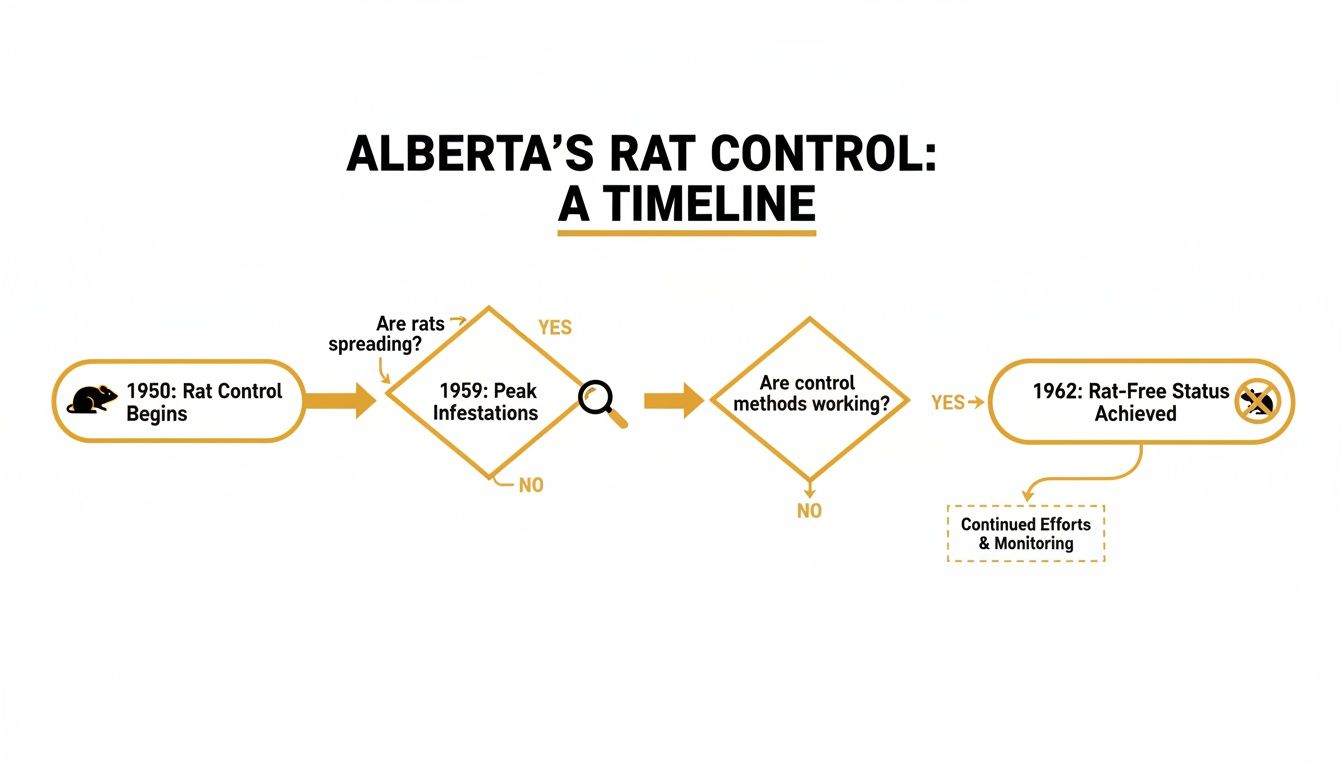
The timeline shows just how quickly officials moved back in the 1950s to stop rats from ever getting a foothold in the province.
These physical differences have big implications for property owners. Size affects behaviour and the risks involved. Rats, weighing 350-500g, can eat 25-30g of food a day and spoil ten times that amount with their urine, which can carry leptospirosis. In contrast, tiny mice at 15-30g only nibble on 3g of food. But their small size is their superpower—they can squeeze through gaps as small as 6mm, while rats need at least 2cm. For Red Deer homeowners and businesses, this means mice require constant vigilance.
For more detailed profiles on pests common to our area, feel free to explore our comprehensive pest library.
Rodent Behaviour and Habits: The Real Differences
It’s not just about looks. The biggest difference between mice and rats is how they act. Understanding their behaviour—how they eat, where they nest, and what they’re scared of—is the key to getting rid of them for good. This is exactly why a trap that catches a mouse might sit untouched by a rat for weeks.
Even though Alberta is thankfully rat-free, knowing these behavioural quirks helps confirm you’re dealing with a house mouse infestation. The clues they leave behind are just as important as what they look like.
Where They Choose to Live
The first major clue is their choice of real estate. Mice are all about convenience and will build their nests as close to a food source as possible.
- Mice: They love soft, warm materials and will shred things like paper, insulation, fabric, or even cotton balls to create a small, cozy nest. You’ll find these tucked away in quiet, undisturbed spots like inside wall voids, attics, behind the fridge, or deep inside a forgotten storage box.
- Rats: The Norway rat, which Alberta works so hard to keep out, is a born burrower. They prefer to dig complex tunnel systems outside, usually along building foundations, under garbage piles, or in dense garden beds. If they do manage to get inside, they’ll stick to the lower levels, like basements and crawl spaces.
The location of the nest tells you a lot. Finding a mouse nest in your kitchen cupboard is a localized problem. Finding a rat burrow outside your foundation suggests a much more serious, ground-level issue that needs a different game plan.
Their Approach to Food (And Traps)
How these rodents think about food is probably their most defining trait, and it has a huge impact on whether your traps and baits will work.
Mice are curious little explorers. They’re known as "nibblers," which means they’ll try tiny bits of many different foods in a single night. This adventurous eating habit makes them much more likely to check out a newly placed bait station or trap.
Rats are the complete opposite. They are neophobic, meaning they are terrified of anything new. They will actively avoid new objects in their environment—including traps—for days or even weeks until they’re convinced it’s not a threat.
A rat’s deep suspicion of new things is why so many DIY baiting attempts fail. They’ll ignore your carefully laid bait and stick to their trusted food sources, which is where professional strategies become essential to outsmart them.
This little behavioural tic is huge. It explains why a snap trap with a dab of peanut butter can catch a mouse overnight, but the same setup could be completely ignored by a rat forever.
How They Get Around
Mice stick close to home. Their territory is small, often just a 3 to 10-metre radius from their nest, provided they have food and water nearby. They are fantastic climbers, so don't be surprised to find them anywhere from the basement to the attic.
Rats are bigger travellers. They will forage much further from their burrows, sometimes covering up to 100 metres a night looking for food. They tend to stick to the same routes, leaving behind greasy "rub marks" on walls and baseboards from the oils in their fur. While some rat species can climb, Norway rats generally prefer to stay at ground level or in sewers.
Knowing these movement patterns helps you figure out what you're up against and where to place traps and monitors for the best chance of success.
Comparing Health Risks and Property Damage

It’s one thing to hear scratching in the walls or find a few droppings. It’s another to understand what that really means for your home and family. The real difference between mice and rats shows up when you look at the specific threats they bring inside. Both are destructive and carry diseases, but the damage they inflict is distinct. Here in Alberta, the common house mouse is the main culprit we see, and knowing the risks is the first step to protecting your property.
While both rodents are a problem, their size and strength dictate the kind of havoc they wreak. Rats are bigger, with powerful jaws that can chew through surprisingly tough materials like soft concrete, aluminum, and hard plastics.
But in Red Deer, it’s the smaller, more common house mouse that poses the most persistent threat. Their tiny, sharp teeth are built for shredding. They’re notorious for chewing through electrical wiring, stripping the insulation right off and creating a major fire hazard inside your walls.
The Dangers Hiding in Your Walls
Often, the damage mice cause goes completely unnoticed until it’s a serious problem. A mouse can slip through a hole the size of a dime, giving it free access to your home’s most vulnerable areas—wall voids, attics, and crawl spaces.
- Electrical Wires: Mice gnaw constantly to keep their teeth filed down, and electrical wiring is a common target. This can cause short circuits, power outages, and, in the worst-case scenario, devastating house fires.
- Insulation Damage: They love to tear up fibreglass and foam insulation to build their nests. This ruins your home's energy efficiency, leaving you with higher bills and unexplained cold spots.
- Structural Gnawing: Over time, mice can chew on wooden studs and drywall, creating a hidden network of tunnels that slowly weakens your home’s structure.
The numbers really drive home the urgency of a mouse problem. Mice are responsible for over $100 million in property losses across Canada every year. Much of that comes from gnawing on wires—a habit linked to as many as 25% of house fires with an unknown origin. While a potential rat outbreak in Alberta could cause massive agricultural damage, the immediate threat to Red Deer homes and businesses comes from mice.
Unseen Health Risks from Mice
The property damage is only half the story. The biggest health risk from mice isn't from a direct bite, but from the constant contamination they leave behind. A single mouse can produce 50 to 80 droppings per day, spreading germs everywhere it goes.
Even after you think the mice are gone, their droppings, urine, and nesting materials can harbour dangerous pathogens for a long time. When these materials are disturbed, the particles can become airborne and easily inhaled.
The most significant health threat from mice in our region is Hantavirus. This is a severe, sometimes fatal, respiratory illness transmitted by breathing in dust contaminated with the urine or droppings of infected deer mice, which are common in rural Alberta.
Other serious diseases linked to house mice include:
- Salmonellosis: A nasty bacterial infection you can get when mice contaminate food or kitchen counters with their feces.
- Lymphocytic Choriomeningitis (LCMV): A viral infection that can cause neurological disease. It’s primarily spread through exposure to fresh urine, droppings, saliva, or nesting materials.
While rats are infamous for spreading diseases like Leptospirosis through their urine, the immediate health concerns for most families in Alberta are directly tied to the house mouse. Their ability to get into pantries, onto countertops, and into living spaces makes them a significant vector for disease.
Protecting your property starts with being proactive. You can find some great starting points in our guide on DIY pest prevention tips for effective pest control in Red Deer.
When to Call a Professional for Your Mouse Problem
Trying to deal with a mouse problem yourself can feel like the right move at first. You put down a few traps, clean up some droppings, and cross your fingers. While DIY methods can occasionally catch a single mouse that wandered in by mistake, they usually don't cut it for an established infestation. Knowing when to hand the job over to a professional is the key to protecting your home and your family's health.
The hard truth is that store-bought traps and baits are often just a band-aid on a much bigger problem. Mice reproduce at an incredible rate. What looks like one or two rodents can quickly explode into a colony of dozens hiding in your walls and attic. If your efforts aren't getting immediate and permanent results, it's a huge red flag that the problem is worse than you think.
Signs Your DIY Methods Are Failing
It’s crucial to know when you're fighting a losing battle. If you spot any of these signs, it's time to call a licensed pest control technician. These aren't just minor setbacks; they're clear indicators that the mouse population is growing right under your nose.
- Persistent Activity: You keep catching mice, but you're still finding fresh droppings or new chew marks. This means they are breeding faster than you can trap them.
- Daytime Sightings: Mice are nocturnal creatures. Seeing one out in the open during the day often means their nests are overcrowded, forcing them out to find food when they're most vulnerable.
- Widespread Evidence: You're finding droppings in multiple rooms or on different floors. This points to a large, well-established colony that has spread throughout your home.
- Strong, Musky Odour: A noticeable and persistent ammonia-like smell, especially in closed-off areas like a pantry or basement, is a dead giveaway of a serious infestation with a lot of urine.
When you can hear constant scratching noises coming from inside your walls or ceilings, you are no longer dealing with a small problem. That's the sound of an active mouse colony that has turned your home's structure into its personal playground.
Why Professional Intervention Is Necessary
A licensed technician brings a level of expertise and equipment that DIY methods simply can't compete with. They know exactly how mice behave here in Alberta and can build a strategy that doesn’t just manage the issue—it solves it for good.
Professionals have access to commercial-grade products that are more potent and work much faster than anything you can buy at the hardware store. They also know how to place baits and traps to get around "bait shyness," which happens when mice get smart and learn to avoid the traps you've set out.
More importantly, a real professional focuses on long-term prevention. They’ll do a full inspection to find and seal every single entry point, from tiny foundation cracks to gaps around pipes. This is the most critical step to stop the cycle of mice getting back in. For those wanting to learn more about the support structures behind effective pest management, insights can be found with pest control answering service solutions.
Ultimately, when you're battling a stubborn mouse problem, you're not just fighting the mice you can see. You're up against a hidden, fast-growing colony. If you’re ready for a definitive solution, our guide explains in detail how to get rid of mice with professional help. Choosing an expert with a solid guarantee ensures the job is done right, protecting your Red Deer home for years to come.
Have More Questions? We Have Answers
Even with all this information, you might still have a few questions rattling around, especially when it comes to dealing with rodents here in Red Deer. We get it. Here are some of the most common questions we hear from homeowners just like you.
What Should I Do if I Think I Saw a Rat in Alberta?
First off, take a deep breath. While Alberta is proudly "rat-free," the odd "hitchhiker" rat can sometimes find its way here on a transport truck. The province's highly effective Rat Control Program depends on everyday people like you to report these rare sightings right away.
If you're sure you saw a rat, the single most important thing you can do is report it. Call 310-FARM (3276) or get in touch with your local municipality. An inspector will come out to verify the sighting and get to work eliminating the pest before it has any chance to get established. Your quick call is our best line of defence.
Are Ultrasonic Repellents Actually Effective for Mice?
We see these devices everywhere, promising to chase mice away with high-frequency sounds that are silent to us. But honestly? The evidence that they work is incredibly thin. Sure, a mouse might be startled by the noise at first, but they get used to it surprisingly fast.
These plug-in gadgets are far from a reliable, long-term fix for a real infestation. You'll get much better results with proven methods like trapping, baiting, and—most importantly—finding and sealing up every last entry point. Don't bet your home's protection on a little plastic box.
Is It Possible to Have Both Mice and Rats at the Same Time?
It's extremely unlikely you'd have both mice and rats infesting the same space. Rats are bigger, meaner, and will actively hunt and kill mice to get rid of the competition for food and shelter.
Because of this aggressive behaviour, the presence of rats usually sends mice packing. Here in Alberta, this question is mostly a hypothetical one. Thanks to the province's successful rat-control program, if you have a rodent problem, it's almost guaranteed to be a mouse problem.
How Can I Tell if a Mouse Infestation Is Getting Serious?
A few droppings might not set off major alarm bells, but a small mouse issue can snowball into a massive problem before you know it. You're probably dealing with a major infestation if you start noticing these signs:
- Daytime Sightings: Mice are nocturnal. If you're seeing them out and about during the day, it's a good sign their nests are overcrowded.
- Constant Scratching Noises: That persistent scurrying or gnawing you hear in the walls isn't just your house settling. It points to a large, active colony.
- A Strong, Musky Smell: A noticeable, ammonia-like odour from mouse urine is a dead giveaway that a significant number of mice have moved in.
- Widespread Droppings: Finding droppings in multiple places—especially in kitchen cupboards and pantries—means you have a well-established population on your hands.
If any of this sounds familiar, DIY methods probably won't cut it anymore. The infestation has grown beyond a few traps, and it's time to call in a professional to get the situation under control for good.
Don't let a mouse problem get out of hand. For fast, effective, and guaranteed pest management in Red Deer, trust the experts at Dragon Pest Control. We provide lasting solutions to protect your home and family. Book Your Service Online Today!
Article created using Outrank