

It’s a classic scene: a flash of movement in your peripheral vision, and you spot a creature with far too many legs scurrying across your floor. That startling sight is usually a house centipede, Scutigera coleoptrata, one of the most common, if unnerving, guests in homes across Canada. While they look like something out of a horror movie, these arthropods are generally harmless to people and are more of a nuisance than a real threat.
Why Are Centipedes Showing Up in My Home?
Finding a centipede doesn't mean your house is dirty. It just means you're offering something they're looking for. Think of them less as invaders and more as opportunistic roommates drawn in by two main things: moisture and food. They aren’t there for you; they’re hunting other household pests.
These critters are surprisingly skilled predators, preying on spiders, silverfish, ants, and other small insects. In fact, seeing a centipede is often a big, flashing sign that you might have a different pest problem hiding in the wings. If there's a buffet of other bugs available, it's only a matter of time before centipedes show up.
Moisture and Shelter Are the Real Magnets
Besides a steady food supply, centipedes absolutely need moisture to survive. This is why you’ll almost always find them in the dampest, most protected corners of your home.
Common hideouts include:
- Basements and cellars
- Bathrooms, especially around drains or leaky pipes
- Crawl spaces
- Underneath sinks or behind appliances
Here in Alberta, our homes often have basements that can get a bit damp, creating the perfect environment for them. As the seasons shift, they’ll also head indoors for shelter, a common behaviour we cover in our guide to keeping winter pests out of your home.
A centipede is basically an environmental indicator. Its presence tells you that a part of your home might have high humidity or a hidden population of other pests. It’s a heads-up, giving you a chance to tackle those root causes before they get worse.
While the house centipede is the one everyone recognizes, Canada is actually home to a wild variety of these arthropods. Believe it or not, there are 66 described species of centipedes in the country, and about 31% of them aren't native. That's more than double the rate for North America as a whole, which just shows how well species like the house centipede have adapted to living right alongside us.
How to Identify Common Canadian Centipedes
Knowing what you’re up against is the first step to getting some peace of mind. While Canada has plenty of centipede species out in the wild, you’re really only likely to cross paths with one or two types indoors, especially here in Alberta. Being able to tell them apart is what turns that moment of panic into a clear plan of action.
The most common eight-legged—well, thirty-legged—visitor is by far the House Centipede (Scutigera coleoptrata). This one has a very distinct, almost wispy look that makes it easy to spot once you know what you're looking for.
Its body is usually a yellowish-grey colour, measuring about 2.5 to 4 centimetres long, with three dark stripes running down its back. But the legs are the real giveaway. It has 15 pairs of incredibly long, delicate legs that almost look like a fringe or a blur when it zips across the floor. The back legs are super long, often twice the length of its body, giving it a unique, feathery silhouette.
The Two Most Common Types
You can relax a bit—the main centipede you'll see inside is the House Centipede. But, you might occasionally spot a Stone Centipede that has wandered in from your garden. They look quite different from each other.
To help you quickly tell the difference, here’s a simple breakdown.
Common Centipedes Found in and Around Alberta Homes
| Centipede Type | Appearance | Typical Location | Behaviour |
|---|---|---|---|
| House Centipede | Yellowish-grey with long, wispy legs. 15 pairs of legs create a "fringe" effect. Looks delicate. | Indoors, especially in damp areas like basements, bathrooms, and closets. | Very fast runner. Hunts other household pests like spiders and silverfish at night. |
| Stone Centipede | Reddish-brown and flattened. Legs are much shorter and more uniform. Looks more robust and segmented. | Outdoors under rocks, logs, and leaf litter. Occasionally wanders inside by mistake. | Slower than a House Centipede. Not adapted for indoor living and usually dies quickly. |
This table should make it easy to figure out which critter you're dealing with. The key difference is almost always the legs—long and delicate means House Centipede, short and sturdy means it's likely a Stone Centipede that lost its way.
This handy decision tree can help you figure out what a centipede sighting really means and why it chose your home.
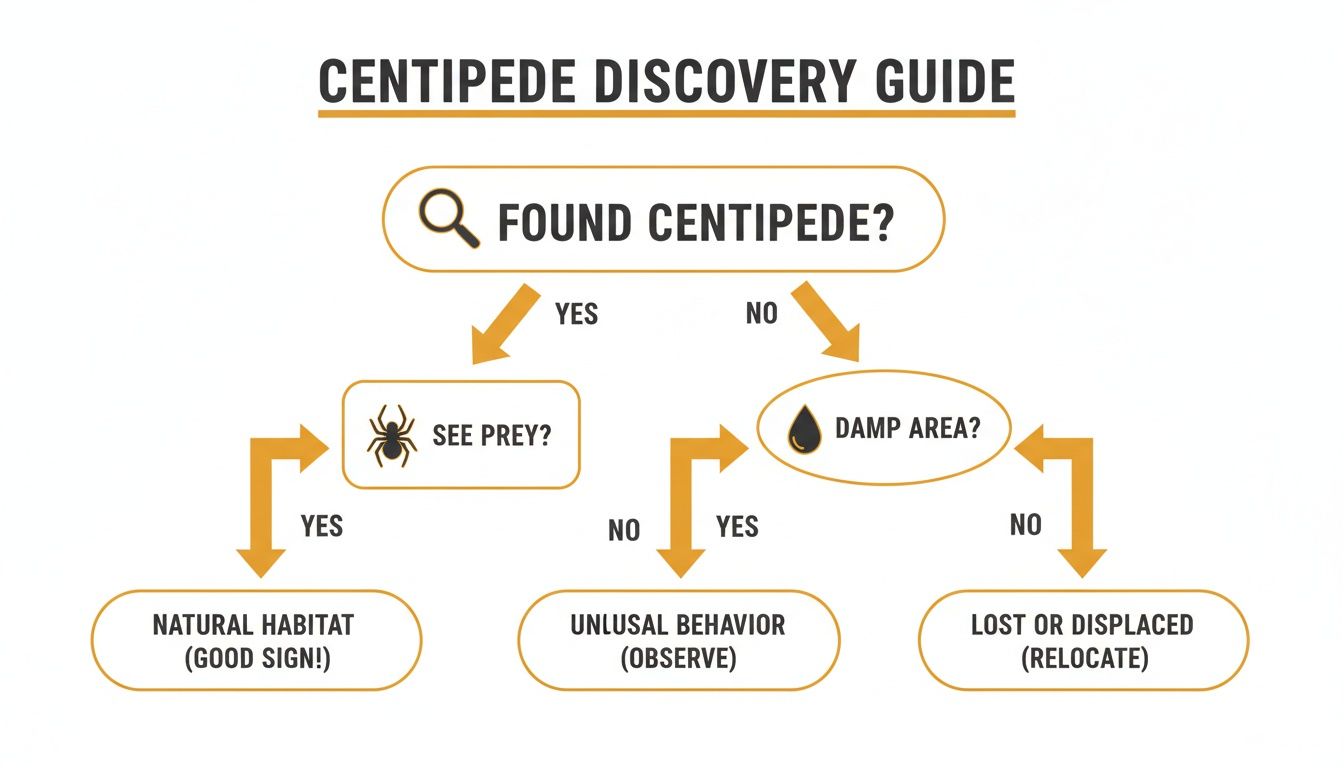
As you can see, a centipede is almost always a messenger. Its presence points directly to an underlying issue, like too much moisture or—more often—a buffet of other pests.
What Does a Centipede Sighting Mean?
Finding a House Centipede scuttling around is a big clue that something else is going on. They are active hunters, so if they're sticking around, it’s because they've found a steady food supply in your house.
The House Centipede is nature's own little pest controller. If you see one, it's a sure sign that it's hunting other critters—usually spiders, silverfish, ants, or cockroach nymphs. The centipede isn't the real problem; it's just the most obvious symptom.
This means that to truly get rid of centipedes, you have to look past them and at what they're eating. For example, if you're seeing more centipedes and more cobwebs, it might be time to look into professional spider pest control.
By getting rid of their food source, you make your home a much less attractive place for these many-legged hunters. This integrated approach tackles the root cause of why they moved in, giving you a much better, long-term solution.
Understanding Why Centipedes Choose Your Home
Centipedes don’t just stumble into your home by accident. Think of them as tiny survivalists on a mission, constantly searching for two things: moisture and food. If you’re seeing them inside, it’s not a random invasion—it’s a signal that your house is offering exactly what they need to thrive.
Unlike many insects, these fast-moving critters lack a waxy outer layer to hold in moisture, which means they can dry out and die very quickly. This vulnerability forces them to seek out damp, protected environments. It’s the single biggest reason you’re more likely to spot centipedes in Canada in specific areas of your home.

Hotspots for Moisture and Prey
Certain spots in a typical Canadian home are basically five-star resorts for centipedes, offering the perfect mix of humidity and a steady food supply.
Common indoor hangouts include:
- Basements and Cellars: Unfinished basements with concrete walls often have higher humidity, creating an ideal environment.
- Bathrooms: The constant dampness from showers and sinks makes bathrooms—especially around drains and under cabinets—a prime location.
- Crawl Spaces: These dark, undisturbed, and often damp areas are perfect for both shelter and hunting.
- Laundry Rooms: A leaky washing machine hose or poor ventilation can create the exact humid conditions centipedes love.
The common house centipede, Scutigera coleoptrata, has adapted so well to living alongside us nationwide, including right here in Alberta, precisely because our homes provide these perfect micro-habitats. A female can lay up to 35 eggs in protected, damp spots like the soil of a potted plant or a tiny crack in a basement floor, letting a population grow completely unnoticed.
Think of a centipede sighting as an environmental clue. It’s your home’s way of telling you that you might have a hidden leak, poor ventilation, or even another pest problem—like spiders, silverfish, or ants—that’s serving as a reliable food source.
Seasonal Shifts and Centipede Behaviour
You’ve probably noticed more centipedes skittering around in the spring and autumn. That isn't a coincidence; it's a direct response to Alberta's changing weather. As the temperatures outside drop or heavy rains set in, centipedes living in the soil, leaf litter, or woodpiles around your foundation will start looking for more stable shelter indoors. Your house is the obvious upgrade.
To get to the bottom of why centipedes are picking your place over your neighbour's, it helps to look at the bigger picture. Sometimes, hidden structural issues are the root cause. Getting insights from a professional property assessment can uncover underlying moisture problems that attract these pests in the first place. Once you start thinking like a pest and identifying their key attractants, you can begin to make your home a much less inviting place for them to settle down.
Debunking Myths About Centipede Bites and Risks
Let's tackle the biggest fear people have about centipedes: are they dangerous? The short answer is no, not really. Even though their creepy appearance and lightning-fast movements can be alarming, the actual risk they pose to you, your kids, and your pets here in Canada is incredibly low. It’s time to separate the horror movie fiction from the facts.
The common house centipede (Scutigera coleoptrata) is, in fact, venomous—but that detail needs some serious context. Their venom is a specialized tool designed to paralyze their tiny prey, like spiders, silverfish, and ants. It simply isn't powerful enough to cause any medically significant harm to a person or even a small pet like a cat or dog.
The Truth About Centipede Bites
For a house centipede to even attempt to bite a human, it has to be completely cornered and feel threatened. Think of it being pinned against your skin by your clothes or tangled in your bedding. This is a total last-ditch defensive move for a creature whose first, second, and third instinct is always to flee.
Even in the extremely rare event that one does bite, their "forcipules"—the venom-injecting claws near their head—are often too small and weak to break through human skin.
If they do manage to get through, the sensation is usually compared to a very mild bee sting. You might see a small, red welt that feels a bit sore for a short while, but it fades quickly. For almost everyone, it's a brief, startling experience with zero lasting effects. Allergic reactions are exceptionally rare.
The real "danger" of centipedes isn't the critter itself. It's what their presence tells you about your home. A steady population of centipedes is a major red flag for underlying issues, like excess moisture that can lead to mould or a hidden infestation of the other pests they’re hunting.
Shifting Your Focus from Fear to Action
Instead of worrying about a potential bite, it's far more productive to see centipedes as helpful messengers. They’re nature’s little inspectors, pointing out problems you might not have noticed. Seeing one is your cue to do a little detective work:
- Check for dampness: Look for leaks under your sinks, in the basement, or around crawl spaces. Are any areas musty or humid?
- Identify their food source: Are you also seeing a lot of spiders, ants, or silverfish? The centipedes are there for a reason.
By addressing the root causes that attract centipedes in Canada, you not only solve your centipede problem but also make your home a much healthier and more secure place overall.
A Practical Prevention Plan to Keep Centipedes Out
The best way to deal with centipedes isn't to chase them around with a shoe—it's to make your home a place they want nothing to do with. A good prevention plan is your strongest defence, turning your property from a five-star centipede resort into a place they’d rather avoid altogether.
This strategy boils down to a simple, two-part approach: get rid of excess moisture and take away their food source.
Think of it like being a bad host. If you stop serving dinner and turn off the water, your unwanted guests will find somewhere else to be pretty quickly. For centipedes, that means drying up the damp spots they need to survive and getting rid of the other household pests they love to hunt.
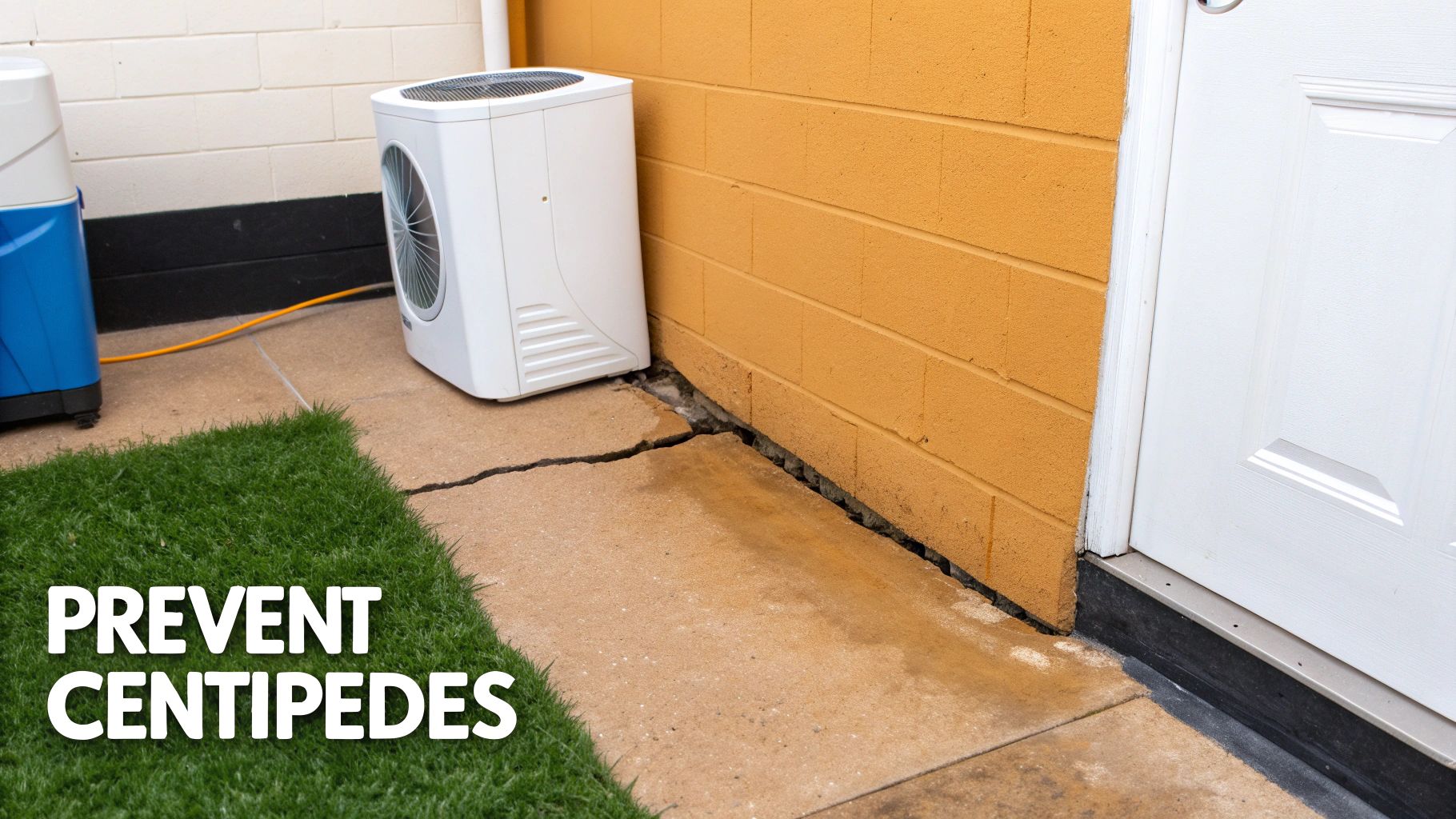
Step One: Control Moisture Levels
Because centipedes can't hold onto water very well, they are biologically hardwired to seek out high-humidity environments. By drying out the damp corners of your home, you make it completely uninhabitable for them. This is the single most effective thing you can do.
Here are a few practical ways to cut down on moisture:
- Run a Dehumidifier: Pop a dehumidifier in your basement, cellar, or any other area that’s always a bit damp. Keeping the humidity consistently low works wonders.
- Fix Leaks Immediately: That slow drip under the sink or a small crack in the foundation is basically a welcome mat for pests. Repair all plumbing issues as soon as you find them.
- Improve Ventilation: Make sure bathrooms, laundry rooms, and kitchens can breathe. Use your exhaust fans to push all that moist air outside where it belongs.
- Check Outdoor Drainage: Take a walk around your house. Ensure your gutters are clear and the ground slopes away from the foundation so water doesn't pool up against the walls.
Step Two: Eliminate Their Food Source
Centipedes are predators. Plain and simple. If there's nothing for them to eat, they have no reason to stick around. By managing other common household pests like spiders, silverfish, and ants, you're effectively cutting off their food supply.
A home with no food is a home with no predators. By managing the populations of smaller insects, you remove the primary reason centipedes are drawn inside in the first place. It’s an indirect but highly effective control method.
This proactive mindset is a core principle of modern pest control. If you're interested in learning more about this strategy, our guide explains what Integrated Pest Management is and how it delivers real, long-term solutions.
A few simple pest-proofing tasks will make a massive difference:
- Seal Entry Points: Get down and closely inspect your foundation for cracks and gaps. Use caulk to seal up any openings around pipes, wires, and vents where critters can sneak in.
- Install Door Sweeps: Add weather stripping and door sweeps to your exterior doors. That little gap at the bottom is like a superhighway for pests.
- Keep It Tidy: Declutter your basement and storage areas. Piles of boxes, stacks of firewood, or old magazines create the perfect hiding spots and hunting grounds for both centipedes and their prey.
So, When Is It Time to Call in a Professional?
DIY prevention is your best first move, but let’s be honest—sometimes a centipede problem gets ahead of us. Knowing when to switch from DIY mode to calling for backup is key. This isn't just about sealing a few cracks anymore; it's about recognizing the patterns that signal a deeper issue.
If you’ve gone from seeing one centipede every so often to spotting them regularly, that's a big clue. An occasional visitor is one thing, but multiple sightings a week tell you that your home has everything they need to thrive: moisture and a steady food source. Your own efforts just aren't enough to disrupt their comfortable setup. This is your first major red flag.
Signs Your Centipede Problem Is Getting Serious
Pay close attention to where you're seeing them. A centipede in a damp basement or a bathroom isn't unusual. But when they start showing up in dry, upstairs areas like bedrooms or the living room? That’s a bad sign. It often means the population has grown so large that they’re being forced out of their prime real estate to hunt for food and new territory.
Another tell-tale sign is the size of the centipedes you’re finding. If you start spotting very small, young ones, you have definitive proof they're breeding right inside your home.
Seeing baby centipedes means you're no longer dealing with a few lost bugs that wandered in from the garden. You're looking at an established, multi-generational infestation that is actively growing inside your walls. This is the moment professional help becomes non-negotiable.
Calling a licensed technician from a trusted company like Dragon Pest Control is the most direct path to a real solution. A pro thinks like a detective. They don’t just spray and leave; they perform a full inspection to find the root cause. Is it a hidden plumbing leak? Or maybe another pest problem, like spiders or silverfish, is providing a buffet for the centipedes?
This expertise lets them use targeted, effective treatments that are much safer for your family and pets than the generic sprays you find at the hardware store. They can get into the hard-to-reach crawl spaces and wall voids where centipedes hide and lay eggs, giving you a long-term fix that truly protects your home and restores your peace of mind.
Your Top Centipede Questions Answered
Even with the best prevention tactics, you might still have some questions about these fast-moving critters. Let's tackle some of the most common concerns we hear from homeowners in Red Deer and across Alberta, so you can handle any centipede sighting with confidence.
Are House Centipedes Dangerous to My Pets?
It’s a fair question, but you can relax. Generally, house centipedes pose almost no risk to your cats or dogs. Their venom is incredibly weak—it’s designed for tiny insects, not mammals—so it’s highly unlikely to cause a serious reaction.
A curious pet might get a sharp pinch if it corners one, but a centipede’s first move is always to run. The biggest worry is usually a bit of an upset stomach if your dog or cat decides to eat one. That said, if you're seeing a lot of them, professional pest control is the best way to keep everyone in your home safe, including the furry family members.
Why Do I Only See Centipedes at Night?
If you only ever seem to spot them after dark, you're seeing them in their element. Centipedes are nocturnal hunters, which means they do their work when your home is dark and quiet.
During the day, they hide away in dark, damp spots—think behind baseboards, down in floor drains, or under a pile of boxes in the basement. They come out at night to hunt for the other pests that might be sharing your space. Spotting one during the day is rare and can sometimes mean the best hiding spots are already taken, hinting at a bigger population.
I Saw One Centipede. Is That a Bad Sign?
Finding a single centipede doesn't automatically signal a full-blown infestation. It could easily be a lone wanderer that found its way inside. But you should definitely treat it as a heads-up.
A lone centipede is a clear signal that your home offers one of two things: moisture or food (other bugs). Its presence confirms that your property has what they need, even if a larger group hasn't settled in yet.
Use that sighting as your cue to run through a quick prevention checklist. Look for leaky pipes, seal obvious gaps around your foundation, and clear out clutter in damp areas like the basement. If you start seeing them more often, that's a pretty clear sign it’s time for a professional inspection.
Do Store-Bought Sprays Actually Work on Centipedes?
A direct hit from a hardware store spray will definitely kill a single centipede. The problem is, that’s not a real solution for getting rid of them. Centipedes are solitary and hide in dozens of hard-to-reach cracks and crevices, so you'll never get them all with a spray can.
A real, lasting solution means tackling the root causes that brought them inside in the first place—that means managing moisture and getting rid of their food source. This is the integrated approach professionals take, and it delivers results that a simple spray just can't compete with.
If you're tired of playing hide-and-seek with these many-legged pests and want a guaranteed, long-term fix, Dragon Pest Control is ready to help. Our licensed technicians will pinpoint the source of the problem and build a targeted plan to protect your home. Request your free quote today and get your peace of mind back.